
What is AEO? How to Optimize Your Website Content for AI Answers
Ask Google, ChatGPT, or Perplexity a question today and you’ll often get a final answer before the first link loads. And if that’s not your website, someone else’s is. Here’s our guide to AEO, how it works and what you can do about it. Step-by-step. Answer Engine improvement Explained: What AEO Really Means. Answer engine improvement (AEO) is all about creating the content that Google-powered AI tools and programs want to see and acknowledge as the correct answer to a question. We’re talking Google AI Overviews ChatGPT Perplexity, voice assistants and the answer boxes that appear at the top of search results. It’s like the next stage of feature snippet work. The previous target was a good link. The new target is being the source the AI cites. That’s a different role, and it favors transparent, straightforward writing rather than relying on keyword manipulations. It also just so happens to favor the sort of content humans want to consume. The New Shape of Search: Why AI Search Tuning Matters Now. Searching was a list. You type one word, get 10 links, click on one and hope for the best. AI search largely eliminates that whole process. Language models read the prompt, determine what you’re really after, and then craft one response from data gathered throughout the internet. The figures reveal how fast these habits are changing. A 2025 Search Engine Land survey revealed that 87% of U.S. Adults have viewed an AI-generated search snippet. By contrast, a Pew Research report found that only 8% of searches accompanied by an AI-generated search snippet resulted in a click on a regular listing. The search is still out there. It just doesn’t always lead to the door anymore. Which is why AI search tuning went from “watch this space” to something you need to act on. Getting the click isn’t the end game anymore. Becoming the source of the AI citation is. Where Do People Actually Use Answer Engines? Anyone not just Google a person could ask ChatGPT for a comparison, take a look at an AI Introduction even though shopping at a retail outlet or utter out a inquiry in excess of to the mobile phone buddy as you go in the course of meal prep. Shoppers use in-store bots even though buying at a retail store. Folks use Perplexity for the reason that it shows them its means. The Throughline is intent. They want an answer, not a playlist. And they’re asking those longer, wordier questions they would have typed with a keyboard similar to “what’s a good accounting tool for a five-person agency?” rather than “accounting software”. Write your page in plain English. Readers want to know about you and your business as simply as possible, especially when they’re searching. AEO, GEO, AIO and LLMO: Cutting Through the Jargon There is a new acronym every few weeks and most agencies are willing to give you a different one. Here’s the fast version. AIO the broadest search intent optimizing content for all discovered and usable by any AI system. AEO more focused – answering questions (eg snippets and voice answers). GEO – (generative search enhancement) is when an LLM tool (e.g. ChatGPT or Gemini) generates a new answer rather than providing a static snippet. Names are close, and some agencies throw them out there on purpose to stay different. Don’t get hung up. They’re all just a different way of saying the same shift from “how do I rank?” to “how do I get cited?” AEO vs SEO: Why You Need Both The AEO vs SEO discussion is mostly a convenient false fight. SEO makes sure your pages are crawled, indexed, and ranked. AEO determines how the material on those pages is brought into answers. If you’re not crawlable, you can’t be cited: those fundamental tech areas still matter: site speed, mobile usability, interlinking, and a clean structure. They appeal to various audiences at various times. SEO is very much still the king when someone is prepared to buy or book high intent searches. AEO is someone who’s still doing their research. Factors SEO AEO Main goal Rank pages and earn clicks Be selected as the direct answer Where it shows Search result listings AI Overviews, snippets, chatbots, voice Success looks like Position, traffic Citations, brand mentions, recall Content style Full pages, broad coverage Direct answers inside well-structured pages Today one person might get your brand in an AI answer and pass over your click to search for your name tomorrow. You won’t find that first hit in your analytics, but it counts. How Do AI Engines Decide What to Cite? No official formula exists, but the trends remain the same throughout the studies. These are the common AI search ranking factors we keep seeing: See what’s not there: keyword density. Answer engines don’t browse for repetition, they extract. A page that hides its answer halfway down the page will lose to one that offers it upfront. Content Strategy for Answer Engines: Build Pages Worth Citing. A good content strategy for answer engines takes one habit. When you approach them, regard every question as a question, and get out the answer first. Follow with an explanation. Now add something only humans are able to produce: any piece of research or data, calculation, or actual project you have completed during your career. Summaries can only refer to existing online information-they’re unable to produce insights of their own. This is perhaps the most useful of the five best AEO practices as it creates another way-beyond first-time-ever-humans and algorithms will have a special reason to quote your work more precisely. How to Write Answers That AI Tools Can Quote. Good writing is simple writing. . How many molecules are in a mole of gas? The answer will be given at the end!Always include an answer to the question, then give three or more points to support your answer. Convert it into a single paragraph or two, but still use good grammar and accurate
AI SEO vs Traditional SEO: What Should Businesses Focus on in 2026?
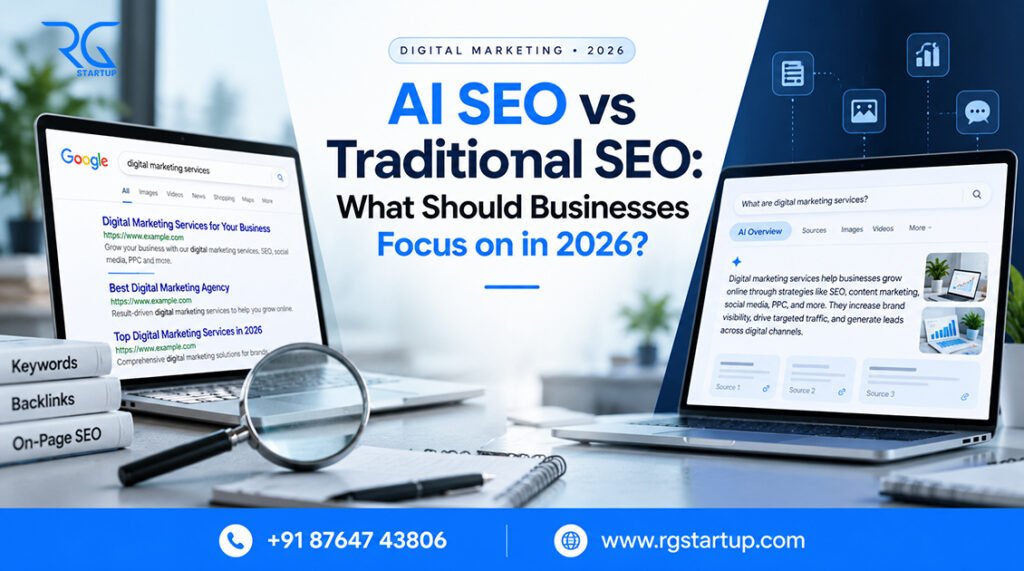
Search has undergone its greatest changes in recent years. While users are still turning to Google to find products, services, and answers, they’re also turning to ChatGPT Gemini Perplexity and other generative AI search options more and more for similar results. In the end, this is something that businesses need to decide. Should we ramp up our investment in SEO or begin shifting our focus further toward AI search? The answer is a little bit of both. Traditional SEO is still the foundation of being found, but AI SEO is beginning to broaden how to think about discovery. Search isn’t just about rankings and website clicks anymore. It’s about brand mentions, citations , answers in AI, and visibility across various types of search experiences. SEO Strategy 2026 for Brands By the year 2026, your SEO Strategy should be all about creating a search presence that is powerful in a traditional as well as an AI world. What is Traditional SEO? General Search Engine Tuning is the process of optimizing a website for search engine results in order for them to crawl, understand, and rank its content for various query topics. Traditional SEO commonly involves: A business cannot expect strong AI visibility if search systems cannot properly access or interpret its website. What Is AI SEO? What does AI SEO do? AI SEO is all about how artificial intelligence systems collect, analyze , summarize, and make recommendations for information. The change is not to simply compare how a page ranks for a keyword AI Search Tuning asks whether the information is too vague for an AI system to comprehend and to use to produce an answer. What does AI SEO relate to? It relates to experiences like AI Overviews ChatGPT Gemini and any other conversational search experiences. It will also focus more on zero-click visibility, where users are presented with the answer without clicking to the website. AI SEO isn’t just about creating masses of UGC or overloading pages with AI keywords. Good structure and in-depth, authoritative, and useful content are still essential. What is Answer Engine Improvement? What is AEO? AEO (answer engine tuning) is aimed at helping the content work well for answer engines that answer specific queries. An AEO is in particular effective for queries like: Short definitions, simple language, and concrete cues aid search and AI systems in understanding this content and referencing it. AEO is not a replacement for SEO, but it can work alongside it. And for business, the main lesson here is that we should not have the key questions hidden in the middle of lengthy paragraphs of contextual material. Content must address the questions head-on, but offer context at the same time. What Is Generative Engine Tuning? What is Generative Engine Improvement? Or GEO is a way of getting an AI to explain, aggregate, and discuss data. AEO is more short but more direct answer GEO is less short, but more comparison and recommendation. If the question is, ‘What is SEO?’ the answer should be just that. If the question is, ‘What is the best SEO strategy for a startup ecommerce business?’ a comparison is required. So here is when the decision between GEO vs SEO comes into the picture. Differences Between AI SEO vs Traditional SEO The difference between AI SEO and traditional SEO is mainly about where and how visibility is achieved. Traditional SEO AI SEO Focuses strongly on keywords Focuses more on topics, entities and context Individual page rankings matter Brand and domain-level clarity matter more Clicks and organic traffic are key metrics Mentions and citations can also matter Optimizes webpages for search results Optimizes information for AI understanding Search engines are the main environment AI-generated answers become another discovery channel Which AI SEO Strategies Should Businesses Focus on in 2026? Companies need to focus on creating customer-friendly, relevant content that hits the mark of the subjects they want to be known for. Some important areas include: Another trend to look for is conversational searches. That can include typing in a lengthy question to an AI system, rather than Google a keyword or keyword phrase. So, topical authority and context is king for AI Search Visibility. Is AI Better for SEO? Some SEO tasks are easier for AI than for humans. AI can analyze massive data sets in no time. AI can assist with keyword grouping, gap analysis of content, research, data analytics and the mundane repetitive aspects of SEO. Strategy and prioritisation that only humans can provide Original insights from others real life experience and understanding of what actually works for the customer. Thus, the best way of all would be human-centric but AI-enabled SEO. AI can speed up the process, but this shouldn’t be a substitute for expert editing. Is AI Replacing SEO? AI will have to help, but answers must come from somewhere websites will need to be found, organised and trustworthy businesses will still need quality content and authority. What is changing is between the search term & the final answer. A user might have once entered a keyword search, clicked on a result, and read an article. Now, that same user might turn to an artificial intelligence platform, pose a long-form question, and receive a summarized answer in response to content from several sources. Which is why Search Engine Optimization still has value and your company needs to gear up for this era of AI discovery. How AI Automation Improves SEO Efficiency and Workflow AI can reduce the time spent on repetitive SEO activities. It can help with: Instead, it should be a means to work smarter, not harder. For those conducting business, it’s better to leverage AI to be more efficient, not prolific. Keyword Research vs. Prompt Research Ancient seo dependence on the keyword research The first step is finding out what your target audience is searching for as well as reviewing the search phrase’s competition, relevance and effectiveness. AI search also adds another element: prompting research. Detailed natural language queries can be
What Is GEO? How Generative Engine Optimization Helps Businesses Get Found in AI Search
The nature of search is evolving. Visitors to the web may still browse to a website, but they’re also turning to AI chatbots such as ChatGPT, Google AI demos and Perplexity for a quick overview of a topic, to compare products or services, and to ask for suggestions. Instead of clicking through dozens of pages, they might get their answer from a dialogue of chunks of text with citations. This presents a new visibility challenge for the business: how can a prospective customer find a brand when an AI application is steering him or her in another direction? Generating Engine tuning (GEO) improves your company’s content and identity online to increase the probability of being recognised, understood , referenced, or talked about in questions posed by artificial intelligence. As with regular SEO, GEO is just like what we’re used to, but firms must also check that their expertise, products, and brands are represented on all the proper online channels. GEO is not a replacement for SEO. It won’t get the AI platform to suggest your business to a name they’re not already searching for, but it is part of a search strategy that includes good content, technical accessibility, relevance, and trust. Want to know how visible your business is in AI search? Get a free consultation from RG Startup or chat with us on WhatsApp. What Is Generative Engine Tuning and Why Does It Matter? What is Generative Engine Tuning? How to make your digital content and brand assets more discoverable, about websites videos images, and text by creating generated answer and search experiences on AI. In some engines, an AI engine pulls content from websites, or other content and generates an answer. Your company can be identified if the AI engine mentions your content as a supporting source or makes an NLP reference to the business brand. GEO is one of the phrases to think about for work to be done to benefit from these user search experiences in generative AI. But the company said its stance is that traditional search engine improvement best practices still apply. Traditional SEO Objective GEO Objective Improve visibility in conventional search results Improve opportunities for discovery in AI-generated responses Attract relevant organic visitors Build visibility across AI-assisted research and discovery Optimize pages for relevant searches Make information relevant, clear and easy to understand Develop useful content and authority Strengthen content quality and the brand’s subject expertise Measure impressions, clicks and traffic Also examine AI mentions, citations and referral opportunities where measurable Consider GEO for the business because by the time someone is ready to call your service provider they might have come across your brand while trying to solve their problem. Easy and informative content can be a part of their research. How Is GEO for Business Changing Brand Discovery? More than anything, our questions are used to compare options. If you’re, for instance, looking at digital marketing companies, your AI assistant could explain what is SEO, how they differ from paid advertising, or what you need to know before you get started. These questions are more than a service keyword, they are a direct response to the customer needs, situation, finances, and buying decision. What does this mean for a business? By sitting on a website and having your services listed it will not get the customer any closer to understanding their wider needs. It is necessary to have some key content that explains: what do we do? How do the services work and why are they useful? Businesses should focus on these areas: Business Type Useful GEO Content IT company Service explanations, technology comparisons and implementation guides Digital marketing agency SEO guides, campaign planning resources and marketing comparisons Ecommerce business Product specifications, usage guidance and product comparisons Healthcare provider Accurate service information and reliable patient education Professional consultant Industry insights, process explanations and practical recommendations Local service provider Service areas, business information, customer FAQs and genuine reviews The objective is to make the business easier to understand and its information more useful to people researching related topics. How Does GEO Differ From Traditional SEO? Factor Traditional SEO Generative Engine Optimization Primary visibility Search engine results pages AI-generated answers and related source links Content approach Relevant pages that satisfy search intent Relevant content that also communicates information clearly in context Technical foundation Crawling, indexing and website accessibility The same foundations remain important Brand presence Website, relevant links and other reputation signals Website content and wider online information may contribute, depending on the platform Content structure Clear headings, sections and internal links The same structure helps readers and supports content understanding Measurement Rankings, impressions, clicks and conversions Those metrics plus AI mentions or citations where they can be measured Expected outcome Organic discovery and relevant website visits Additional opportunities for discovery through AI-assisted experiences GEO won’t be a completely new marketing channel that supersedes all existing SEO activities. Per Google’s own guidance, the search generative experience in Google Search will be built on Search’s core ranking and quality systems. What GEO Strategies Help Businesses Improve AI Search Visibility? A robust GEO plan doesn’t require filling a site with keywords like ‘Ai Search Improvement’ over and over. Though it does require for the information to be helpful, nicely formatted and indexed appropriately. 1. Create original, helpful content Give responses that are answers to the questions real clients are asking, and that add some element that you can’t get anywhere else on the Internet. Helpful stories, clever suggestions, personal experience, or other thoughtfully observed facts are worth something. 2. Use clear headings and direct answers Try and name each page having a unifying theme. State what the page will be about and explain what information you are going to give with more detail with what clarification you are going to give then state what your thoughts and decision. 3. Explain your business consistently Accurately describe your service and company information, both on your website and related directory profiles. Do not create inconsistency by describing