The nature of search is evolving. Visitors to the web may still browse to a website, but they’re also turning to AI chatbots such as ChatGPT, Google AI demos and Perplexity for a quick overview of a topic, to compare products or services, and to ask for suggestions. Instead of clicking through dozens of pages, they might get their answer from a dialogue of chunks of text with citations.
This presents a new visibility challenge for the business: how can a prospective customer find a brand when an AI application is steering him or her in another direction?
Generating Engine tuning (GEO) improves your company’s content and identity online to increase the probability of being recognised, understood , referenced, or talked about in questions posed by artificial intelligence. As with regular SEO, GEO is just like what we’re used to, but firms must also check that their expertise, products, and brands are represented on all the proper online channels.
GEO is not a replacement for SEO. It won’t get the AI platform to suggest your business to a name they’re not already searching for, but it is part of a search strategy that includes good content, technical accessibility, relevance, and trust.
Want to know how visible your business is in AI search? Get a free consultation from RG Startup or chat with us on WhatsApp.
What Is Generative Engine Tuning and Why Does It Matter?
What is Generative Engine Tuning? How to make your digital content and brand assets more discoverable, about websites videos images, and text by creating generated answer and search experiences on AI. In some engines, an AI engine pulls content from websites, or other content and generates an answer. Your company can be identified if the AI engine mentions your content as a supporting source or makes an NLP reference to the business brand.
GEO is one of the phrases to think about for work to be done to benefit from these user search experiences in generative AI. But the company said its stance is that traditional search engine improvement best practices still apply.
| Traditional SEO Objective | GEO Objective |
|---|---|
| Improve visibility in conventional search results | Improve opportunities for discovery in AI-generated responses |
| Attract relevant organic visitors | Build visibility across AI-assisted research and discovery |
| Optimize pages for relevant searches | Make information relevant, clear and easy to understand |
| Develop useful content and authority | Strengthen content quality and the brand’s subject expertise |
| Measure impressions, clicks and traffic | Also examine AI mentions, citations and referral opportunities where measurable |
Consider GEO for the business because by the time someone is ready to call your service provider they might have come across your brand while trying to solve their problem. Easy and informative content can be a part of their research.
How Is GEO for Business Changing Brand Discovery?
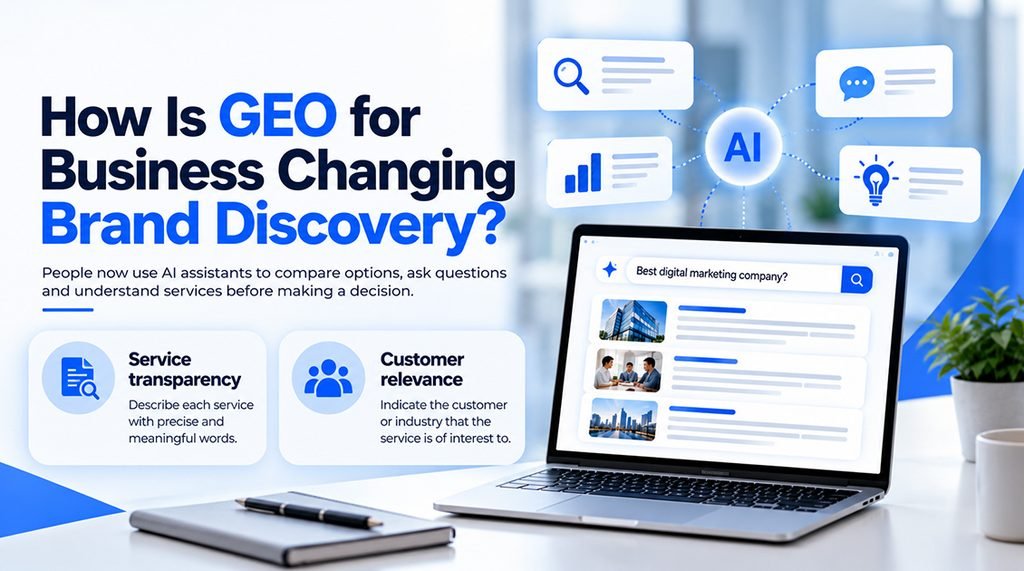
More than anything, our questions are used to compare options. If you’re, for instance, looking at digital marketing companies, your AI assistant could explain what is SEO, how they differ from paid advertising, or what you need to know before you get started.
These questions are more than a service keyword, they are a direct response to the customer needs, situation, finances, and buying decision.
What does this mean for a business? By sitting on a website and having your services listed it will not get the customer any closer to understanding their wider needs. It is necessary to have some key content that explains: what do we do? How do the services work and why are they useful?
Businesses should focus on these areas:
- Service transparency: Describe each service with precise and meaningful words.
- Importance to the customer: Indicate the customer or industry that the service is of interest to.
- Reassuring business data: make sure you have the correct descriptions and fundamental information on the right profiles.
- The useful educational content: will answer the questions customers have Before Purchase.
- On the topic: give helpful advice. Do not simply restate the same old, uninteresting details you find from other sources.
- Trust signals: show real experiences, relevant proof and truthful company information.
| Business Type | Useful GEO Content |
|---|---|
| IT company | Service explanations, technology comparisons and implementation guides |
| Digital marketing agency | SEO guides, campaign planning resources and marketing comparisons |
| Ecommerce business | Product specifications, usage guidance and product comparisons |
| Healthcare provider | Accurate service information and reliable patient education |
| Professional consultant | Industry insights, process explanations and practical recommendations |
| Local service provider | Service areas, business information, customer FAQs and genuine reviews |
The objective is to make the business easier to understand and its information more useful to people researching related topics.
How Does GEO Differ From Traditional SEO?
| Factor | Traditional SEO | Generative Engine Optimization |
|---|---|---|
| Primary visibility | Search engine results pages | AI-generated answers and related source links |
| Content approach | Relevant pages that satisfy search intent | Relevant content that also communicates information clearly in context |
| Technical foundation | Crawling, indexing and website accessibility | The same foundations remain important |
| Brand presence | Website, relevant links and other reputation signals | Website content and wider online information may contribute, depending on the platform |
| Content structure | Clear headings, sections and internal links | The same structure helps readers and supports content understanding |
| Measurement | Rankings, impressions, clicks and conversions | Those metrics plus AI mentions or citations where they can be measured |
| Expected outcome | Organic discovery and relevant website visits | Additional opportunities for discovery through AI-assisted experiences |
GEO won’t be a completely new marketing channel that supersedes all existing SEO activities. Per Google’s own guidance, the search generative experience in Google Search will be built on Search’s core ranking and quality systems.
What GEO Strategies Help Businesses Improve AI Search Visibility?
A robust GEO plan doesn’t require filling a site with keywords like ‘Ai Search Improvement’ over and over. Though it does require for the information to be helpful, nicely formatted and indexed appropriately.
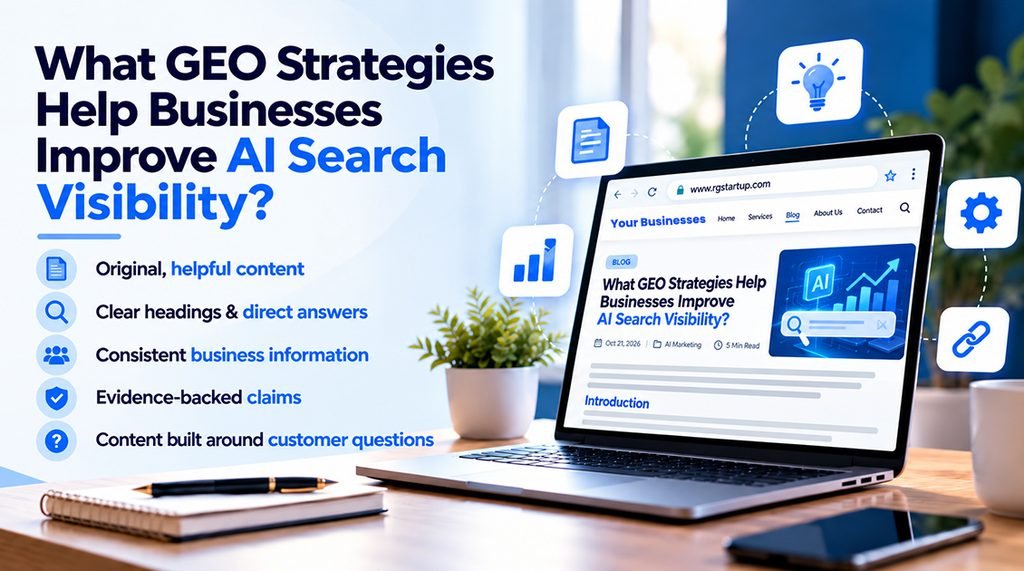
1. Create original, helpful content
Give responses that are answers to the questions real clients are asking, and that add some element that you can’t get anywhere else on the Internet. Helpful stories, clever suggestions, personal experience, or other thoughtfully observed facts are worth something.
2. Use clear headings and direct answers
Try and name each page having a unifying theme. State what the page will be about and explain what information you are going to give with more detail with what clarification you are going to give then state what your thoughts and decision.
3. Explain your business consistently
Accurately describe your service and company information, both on your website and related directory profiles. Do not create inconsistency by describing your service differently or by contradicting your service by location or focus.
4. Support claims with evidence
Use authentic examples and references, substantiated data or anecdotal evidence at all times. Where relevant, maintain credibility through avoiding unwarranted use of adjectives and unreferenced comments.
5. Develop content around customer questions
Create valuable pages around awareness, research, comparison, and purchase intent instead of dozens of pages for each small keyword variation.
| GEO Practice | Practical Action | Intended Benefit |
|---|---|---|
| Content quality | Add original insight and useful examples | Gives readers a stronger reason to use the page |
| Content structure | Use descriptive headings and logical sections | Makes information easier to navigate |
| Technical SEO | Check crawling and indexing | Helps search engines access eligible content |
| Business clarity | Describe services and expertise accurately | Reduces ambiguity about the brand |
| Internal linking | Connect relevant service pages and guides | Helps users discover related information |
| Evidence | Support factual claims with reliable sources | Improves the usefulness and credibility of content |
| Content maintenance | Review outdated information | Keeps important details accurate |
Google suggests that instead of rehashing what is readily available elsewhere, make helpful content of your own. Not multiple pages of content to boost the number of pages AI sees.
Why AI Search Visibility Depends on More Than Your Website
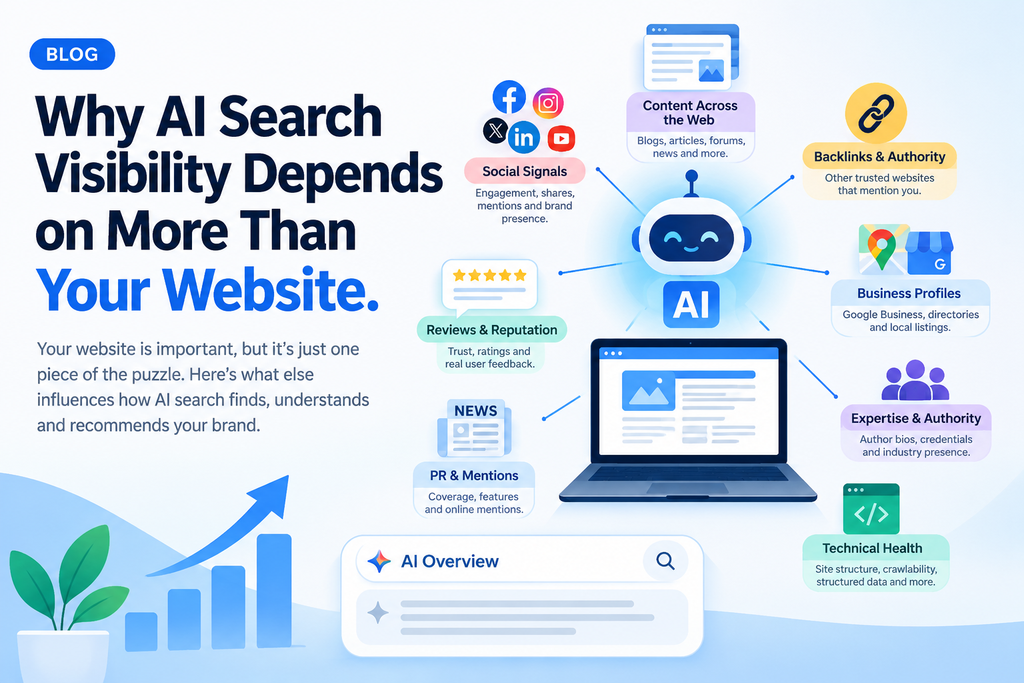
While a company’s website is a good resource to understand their offering, other websites and sources online are potentially where an AI platform may find data to help answer your query, given the platform and question.
A consistent, authentic online presence is helpful. But companies don’t need to create mentions all around the world. They need to keep their profiles accurate, share valuable knowledge and gain appropriate recognition naturally.
Some methods to improve your wider online profile are:
- Ensure the correctness of your company information on relevant sites.
- Share valuable industry information and education.
- Involve yourself in the appropriate relevant professional conversations.
- Share a demonstration, video or explanation you have done.
- Get real customer reviews – don’t fake them.
- Fix inaccurate or inconsistent business data.
- Request real industry coverage when you have a real story to tell or real contribution to make.
| Online Asset | How It Can Support Brand Visibility |
|---|---|
| Official website | Provides primary information about services and expertise |
| Business profiles | Communicate important business details |
| Industry publications | Can provide relevant external coverage |
| Educational videos | Explain services and demonstrate knowledge |
| Genuine customer reviews | Offer customer perspectives on actual experiences |
| Professional profiles | Help identify company representatives and their expertise |
| Relevant discussions | Can provide additional context about industry questions |
You don’t want to get as many mentions as you can. Google has repeatedly advised against the search for false mentions as a form of AI search. Real credibility and value are more important.
How Can Businesses Make Content Easier for AI Systems to Understand?
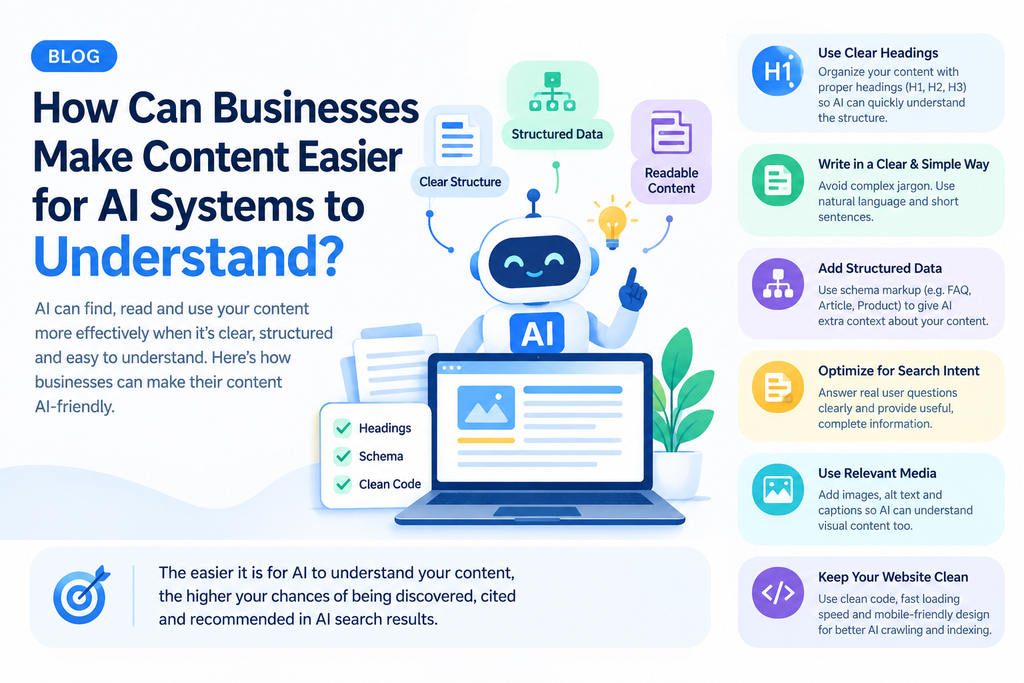
Content should be for people first. But content structure helps users find what they want and make the page browsable.
Use this content checklist:
- Lead with the main point of the page here. Keep every fact intact and original length.
- Introduce with descriptive titles of each section.
- Explain any technical words when they first use them.
- Break up paragraphs into one main idea. Avoid paragraphs with several different ideas.
- Provide examples to illustrate difficult ideas.
- Tables should only be used to enable comparisons.
- Show proof for your important arguments.
- Make sure to link to other detailed information that you have access to.
- Check all facts are current. Keep descriptions of services accurate.
- Remove unneeded words that don’t add to the reader’s understanding.
| Content Element | Recommended Approach | Avoid |
|---|---|---|
| Introduction | Explain the topic and why it matters | Long introductions that delay the answer |
| Headings | Describe the section’s actual subject | Repetitive, keyword-stuffed headings |
| Paragraphs | Explain one connected idea clearly | Repeating the same point in different words |
| Examples | Use realistic, relevant examples | Invented case studies presented as real |
| Tables | Compare options or summarize complex details | Turning every paragraph into a table |
| Keywords | Use relevant terms naturally | Unnatural repetition |
| References | Use reliable sources for factual claims | Unsupported claims presented as facts |
Google recommends against splitting every article into small chunks or editing out every sentence to prepare content for AI. Google states that there is no optimum length of content or unique content segmentation criterion for its AI-generated search experiences. Write your content based on the topic and the audience.
GEO Marketing: How to Build a Practical Improvement Plan
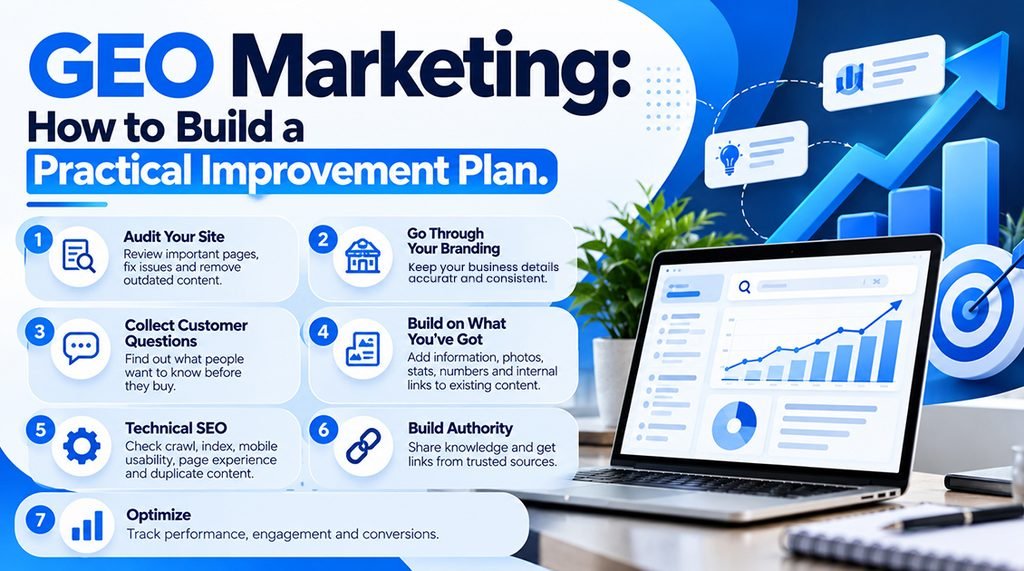
Companies do not need to overhaul their complete marketing plan all at once. Instead, the most significant initial step is to have a look at the website and identify the weak places, and then concentrate on improvements that will support conventional search and also AI search.
A practical GEO implementation process
Step 1. Audit your site. Look at your service pages and blog posts. Which ones make you feel excited? Check for indexing problems. Get rid of content that’s no longer useful or has broken links.
Step 2. Go through your branding. Make sure your business name, address and specialties are all correct and consistent.
Step 3. Collect customer questions. Think about what people want to know before they decide to buy from you. Write down those questions.
Step 4. Build on what you’ve got. Before you create pages, fill in the gaps. Add info photos, stats, numbers and internal links to your existing content.
Step 5. Technical SEO. Check crawl, index, mobile usability, page experience and duplicate content. Make sure your site works well for search engines and users.
Step 6. Build Authority. Share your knowledge. Create real useful links to trusted magazines and websites in your field. Become the go-to source.
Step 7. Optimize. Watch how your site performs in search. Check website engagement, conversions and signals that your content is being seen and trusted by search engines.
| Stage | Main Activity | What to Review |
|---|---|---|
| Audit | Review existing website | Important pages and technical issues |
| Research | Understand customer questions | Search intent and content gaps |
| Optimization | Improve existing pages | Clarity, usefulness and accuracy |
| Expansion | Create genuinely needed resources | Missing topics and supporting guides |
| Authority | Strengthen legitimate online presence | Relevant coverage and brand consistency |
| Measurement | Review performance | Traffic, conversions and available AI visibility data |
This process aids businesses in developing better searching foundations without falling for the false hopes and hoodwinking promotional strategies of false AI recommendations.
Ready to improve your AI search visibility?
RG Startup’s team can audit your website, fix technical issues and build content around what your customers actually ask. Request a Free Consultation | WhatsApp Us | Call +91-9592175214
How Should Businesses Measure GEO Performance?
Measuring GEO may be more complex than organic traffic. A product could have appeared in a QA answer, but not been clicked, then a user could later come to its website through other means.
Because of this, it makes sense for firms to differentiate between hard outcomes and visibility signals, which alone provide somewhat reliable but incomplete evidence.
| Metric | What It Measures | Important Limitation |
|---|---|---|
| Organic impressions | How often pages appear in eligible search results | Does not prove AI citations increased |
| Organic clicks | Visits generated through search | Does not capture every brand exposure |
| Referral traffic | Visits attributed to identifiable sources | Some AI-related visits may not be clearly attributed |
| AI mentions | Brand appearances in sampled AI responses | Results can vary by query, platform and time |
| Citation frequency | How often the website is referenced in sampled responses | Sampling may not represent all users |
| Share of voice | Brand visibility relative to selected competitors | Depends on the queries and platforms measured |
| Leads and conversions | Business outcomes associated with visits | Attribution may involve multiple channels |
Tools and methods to consider
- Search Console: Look over search impression data, click data, query details and page information. Use any generative AI reporting tools in your account.
- Traffic report: Check traffic sources to see which landing pages are getting the most visits, track enquiries and measure conversions.
- Manual AI questions: Run the search queries on other websites and check if your business name or website appears.
- Search Competitor Comparison: Do the search query again and repeat the same steps to compare results, with other competitors.
- Change over time: Regularly compare notes between you.
Google recommends monitoring your AI search features using Search Console and be cautious of third-party tools that claim to give access to Google’s ranking or AI tools.
Common GEO Myths Businesses Should Avoid
The growing popularity of AI search has generated a lot of advice about “special” files, technical “hacks” and “sure fire” rankings. Firms should review this advice carefully before committing time or money.
| Common Claim | What Businesses Should Know |
|---|---|
| GEO replaces SEO | GEO builds on many established SEO principles |
| AI keywords guarantee citations | Keywords alone cannot guarantee inclusion |
| Every question needs a separate page | Pages should address genuine user needs |
| llms.txt is required for Google AI visibility | Google says it does not use llms.txt for Search visibility |
| Special AI schema guarantees inclusion | Google does not require special AI schema |
| More content always means more visibility | Quality and usefulness matter more than page count |
| Artificial mentions improve AI visibility | Inauthentic mentions are not a sustainable strategy |
| A provider can guarantee AI recommendations | AI responses and source selection cannot be guaranteed |
Structured data can still provide an uplift to standard SEO and achieve some Search features if used appropriately. It has to correspond to the existing content on the page and shouldn’t be used as a cheat to cover up an AI citation.
How RG Startup Can Help Businesses Improve AI Search Visibility
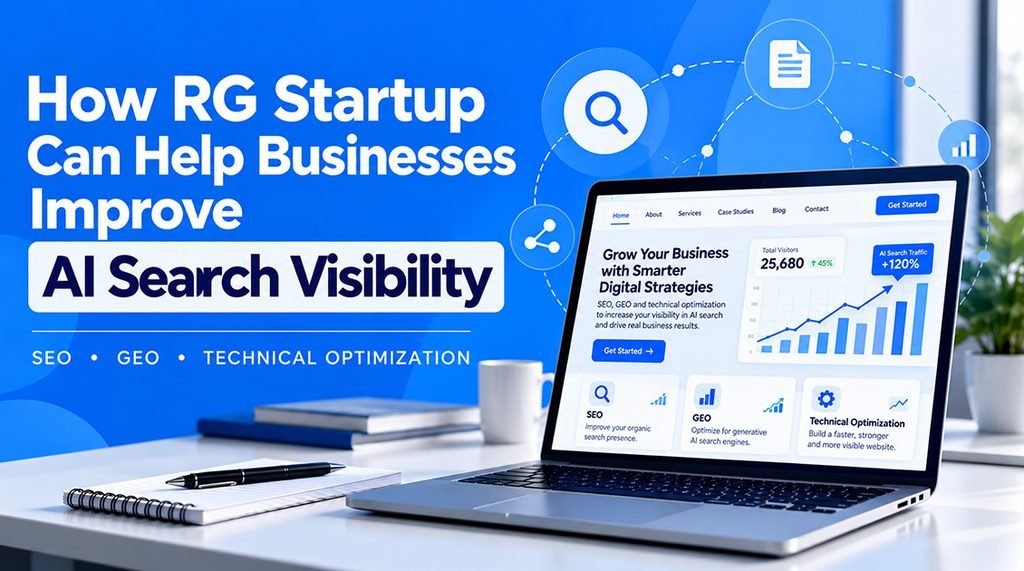
To increase AI’s visibility in search, your website needs to be easy to understand, with valuable information, and a technically solid website.
The team can also help optimise content as well as identify and improve technical performance issues. This support can help lay the foundations for the wider search that companies will have to adapt to in the age of AI-enabled discovery.
| Area of Support | How It Contributes to Search Readiness |
|---|---|
| Website audit | Identifies content and technical issues |
| Keyword and topic research | Helps identify customer needs and content opportunities |
| On-page SEO | Improves page structure, relevance and clarity |
| Content development | Builds useful resources around customer questions |
| Technical SEO | Addresses crawling, indexing and website accessibility |
| Digital marketing | Supports broader online visibility |
| Performance monitoring | Helps identify areas for continued improvement |
If you are a business looking for GEO services, you should focus on a realistic strategy and not promising guaranteed rankings of AI. RG Startup can treat AI search readiness as part of an overall SEO strategy coupled with digital marketing, with performance based on web page needs.
Let’s make your business easier to find in AI search
Contact RG Startup Today | Chat on WhatsApp
FAQs About Generative Engine Tuning
1. What is Generative Engine Tuning?
GEO is the service of optimising content and brand attribution so that businesses stand a greater chance of being found, referenced, or mentioned in AI-generated answers.
2. Is GEO replacing traditional SEO?
No. The notions that comprise GEO are based on many principles that have long been established in the world of SEO, like accessible, high-quality content; easy to navigate website structures; and logical internal linking.
3. Why is GEO important for businesses?
This can help businesses get ready for customer research using AI-powered search tools and assistants that look at options and locate service providers.
4. Does GEO promise that ChatGPT or Google AI will talk about my business?
No. How your answer shows up on platforms depends on the question and the situation. There is no way to know where your answer will come up or how it will be presented.
5. Does GEO only involve website content?
No. Beyond a business’s websites and other related online properties, its wider online existence may also factor into how the brand and/or services are perceived, according to the platform and the query.
6. Do businesses need special GEO tools or llms.Txt?
There’s no additional llms. Txt or any other Google Search tool. Businesses will want to continue to focus on SEO basics and do due diligence on any third-party tools.
7. How long does GEO take to show results?
How long will it take? Not fixed, the timeframe can vary based on the current state of the website, type of content, competition, and how traffic / visibility is being measured.
8. How can RG Startup support GEO?
RG Startup’s SEO and other content-related and digital marketing services can improve how organizations structure their website, content, and overall search visibility.