Online presence has become an area very important in real estate marketing. Today, buyers, investors, tenants, or property sellers are researching various options through search engines, social networks, property portals and review sites long before they meet in person with an agent or visit a property.
For a real estate agency builder, independent realtor or property consultant, digital marketing cannot be only about uploading photos of properties on the internet. Digital marketing means creating visibility, offering valuable content, creating enquiries and establishing a process, which leads a prospect from their first online contact to a site visit to signing a property contract.
So, a successful digital marketing approach for real estate must integrate SEO, local search content social marketing, paid advertising websites lead management and customers follow-up. The choice of the optimum mix will be dictated by the property type of business, target market, location, and marketing goals.
What Does Digital Marketing Mean for Real Estate?
Real estate digital marketing: refers to marketing real estate through the internet. Promoting properties for sale or rent, creating brand awareness and generating enquiries by use of various online channels such as search engines, online maps, social media websites, paid advertising, email, and messaging platforms.
The goal is not to be everywhere, this is impossible. This is about the real estate enterprise being in the platforms where their potential customers are doing research and seeking information.
For example, a person looking for a property in a specific area may find an agency via Google Search or Google Maps. A prospective buyer may come to an agency’s website after viewing a property video via Instagram. A commercial property investor may find a company through LinkedIn after reading a market report.
This is also the reason why the effectiveness of real estate marketing is higher when several marketing channels are supporting the same customer journey and not working on their own.
Digital Marketing Should Support the Entire Property Buying Journey
Real estate tends to require more consideration than the typical purchase in our everyday lives. A prospect may evaluate location price builder specifications available facilities, customer reviews and mortgage options before approaching a business.
| Customer stage | What the prospect may do | Useful digital channels |
|---|---|---|
| Awareness | Searches for locations, property types or investment information | SEO, content, social media |
| Consideration | Compares properties, prices and developers | Property pages, videos, guides, reviews |
| Decision | Requests information or books a visit | Landing pages, PPC, WhatsApp, forms |
| Conversion | Visits property and discusses the transaction | CRM, sales follow-up, email |
| Post-purchase | Shares experience or considers another property | Email, reviews, referral communication |
A strong strategy therefore needs to answer the prospect’s questions at each stage rather than focusing only on generating an initial enquiry.
How the Modern Real Estate Customer Journey Works
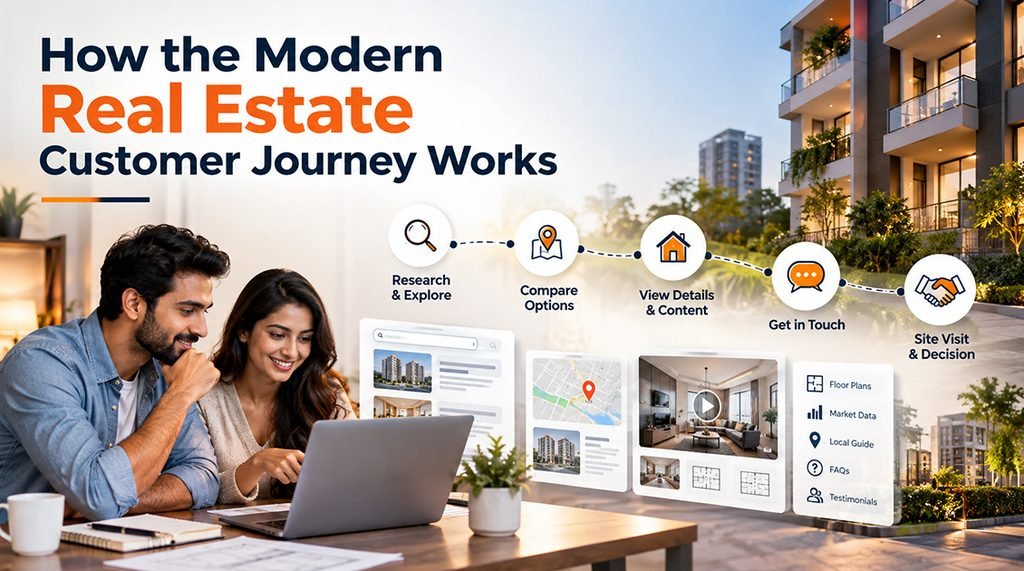
The prospect’s digital journey leads up to their consideration of a specific property. It could be the search for more information about the location, property values, investment potential or the steps involved in property purchase.
Since they are getting more educated, they’re search is getting more refined. They look at 2-BHK or 3-BHK, they look at a particular locality or they search for commercial space in a particular business zone.
At the same stage, the more content and in-depth property data can be used to maintain business presence until the prospect makes up their mind to compare with other alternatives. Property videos, floor plans, local guides, market data, FAQ and customer testimonials can be used here.
From time to time, the lead may opt for direct communication by requesting a call back, shooting a message on WhatsApp, submitting a form or making a site visit. This is the time for sales and marketing to join forces. It is only the first step, not sufficient for the business.
How Can SEO Improve Real Estate Visibility?
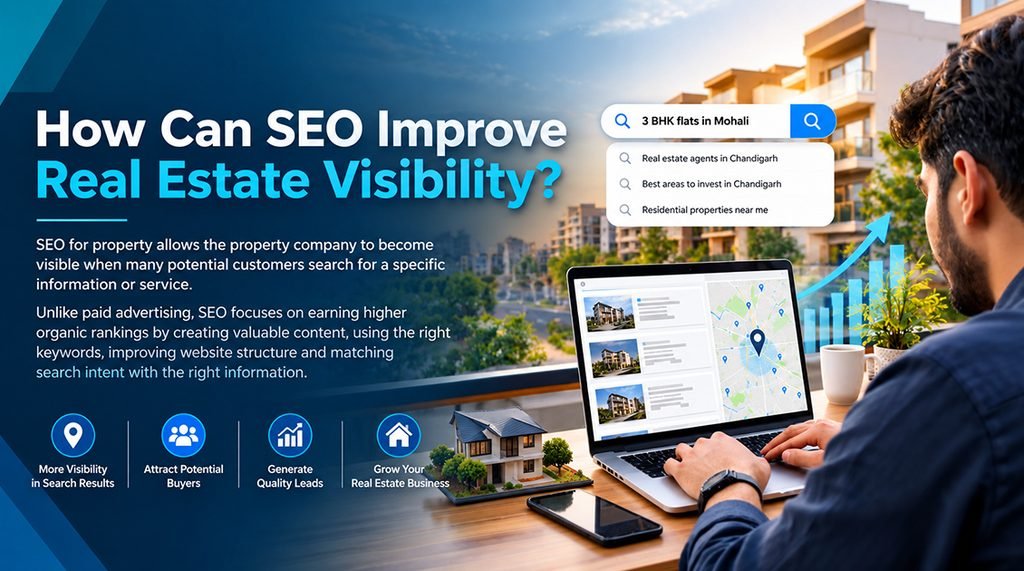
SEO for property allows the property company to become visible when many potential customers search for a specific information or service.
The search engine optimization differs from the paid advertising as it concentrates on drawing the naturally high positioning by creating a beneficial material on the sites, internal structure, search engine appropriate keywords and harmonious relation between the reader’s search and the displayed data.
There are various types of searches that real estate SEO can be optimized for. It can be a service search like real estate agents in Chandigarh, it can be for a property like 3 BHK flats in Mohali or an information search like the best areas to invest in Chandigarh.
These searches are all different levels of intention.
Build Content Around Real Search Behaviour
Keyword research is not just about spamming your primary keywords. A real estate Web site could be built on locations, property types, questions from buyers, investment topics, legal information and local markets.
For example, a website targeting a particular city could create:
- Location and neighbourhood guides
- Property-specific landing pages
- Home-buying guides
- Investment-related articles
- Property price information
- Legal and documentation guides
- Local market updates
This results in a more extensive content structure, with a key main page linking to supporting articles within the site through link insertion. The source article identifies this as a hub and spoke strategy featuring pillar content, cluster content, and internal linking.
Optimise Property and Service Pages
A real estate website should not be solely a homepage for search engines. Individual property pages, location pages and even service pages can be much more relevant.
A good property page will clearly communicate what you are selling, and what action you want the visitor to take next. Key information might be the type of property location, points of interest, photos , layout plans, news, and notes, and an obvious way to enquire.
The intent is that the page is valuable both to the individual conducting the search and to the business.
Why Local SEO Matters for Property Businesses
In fact, real estate is very much related to geography. Buyers and sellers tend to search by a city name, a neighbourhood, a location or the ” near me” phrase. It makes real estate local SEO very relevant for any agency or property professional local expertise.
Google Business Profile – Google business profiles can assist with local visibility with core business information including Name Address Phone Website hours Business categories & Photos. Ensuring this information is consistent on the relevant directories can also help ensure accurate data.
Reviews are also a big part of local presence. If someone is using the product they should be genuinely encouraged to leave feedback about it and this feedback should be replied to in an appropriate manner. This includes negative responses.
Local content could boost this strategy. Rather than merely producing general real estate articles, the agency could develop valuable insights into the region it serves, such as comparing localities, transport, and access, local facilities and lifestyle, and property trends and buyer factors etc.
It’s not about bringing more visitors, it’s about bringing the right visitors; that is, who are actually searching for real estate or properties in the markets being offered.
How Can Content Marketing Support Real Estate Marketing?
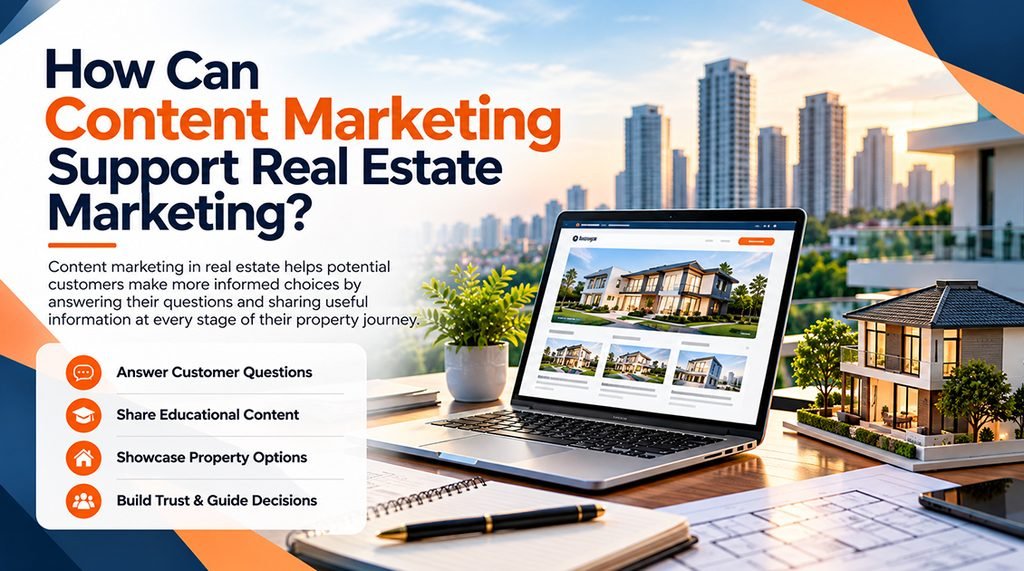
Content marketing in real estate should display the power to help potential customers make more informed choices.
There are various ways in which a property business has the chance to help questions, which are asked before, at the time of and following the research. A first time buyer may seek information on choosing a property. An investor may seek market data. A commercial tenant may seek consistency of locations.
This gives real estate agents the chance to produce material that is not directly related to property selling.
Create Content Around Customer Questions
A useful real estate content strategy can combine educational and commercial content.
For example:
Educational content
- How to evaluate a residential locality
- Questions to ask before buying a property
- Factors that influence property prices
- Guide to property documentation
- Residential versus commercial property considerations
Commercial content
- Properties available in a specific locality
- New residential projects
- Commercial office spaces
- Property consultation services
- Real estate investment opportunities
The balance is important. If every piece of content is “sold, ” prospects will have little incentive to consume it. An informative piece of content can get them comfortable before they get to the decision.
Make Real Estate Content More Visual
Property is a visual product, and so using photographs and video can have a significant impact on it being marketed online.
Property walk-through videos, short form videos floor plans location footage, 360 degree virtual tours can also help customers visualize properties before visiting. The source material speaks of virtual tours and market reports as being a useful way to guide customers through the final decision and establish expertise.
Real images of properties are usually best, rather than generic stock photos. Because everything in the photo relates to the actual property, town, or team, which powers the business.
How Should Realtors Use Social Media Marketing?
The social media marketing for real estate should clearly not become a case of simply uploading pictures of property.
The platform and content must be targeted at the audience. Lifestyle visual content, short property videos, testimonials, and information about the local area can all work when marketing residential properties. Professional market information, availability, and investment-related content are more appropriate for commercial property.
A useful social media strategy can combine three broad content areas:
| Content type | Purpose | Examples |
|---|---|---|
| Educational | Help prospects understand the market | Buying tips, market updates, property guidance |
| Property-focused | Present available opportunities | Walkthroughs, floor plans, features |
| Trust-building | Demonstrate credibility | Client stories, handovers, team content |
For instance, LinkedIn could be great for communicating with your CRE audiences, and Instagram and Facebook for visual-driven marketing of residential properties.
How Do Google Ads and Meta Ads Generate Property Leads?
Paid advertising can ensure properties are seen by potential customers without waiting for rankings to build.
Google real estate ads are very beneficial when individuals are searching for an actual property or service. Search phrases can be a strong indication of intent like ‘cheap Bnb hotels’ and ‘house in mohali’.
In comparison, Meta advertising may, for example, take a different route. Facebook and Instagram may make use of content of properties visually, targeted audience and lead forms to bring properties in front of potential clients.
What comes next is used for different purposes.
| Google Ads | Meta Ads |
|---|---|
| Captures active search demand | Helps create and stimulate interest |
| Useful for high-intent searches | Useful for visual property promotion |
| Search keywords guide targeting | Audience characteristics guide targeting |
| Can direct users to specific landing pages | Can use videos, carousels and lead forms |
The source article suggests directing paid visitors to a specific property page rather than a search engine optimized homepage. A visitor that clicks on a paid ad for a specific property should have the option to view relevant information and make an inquiry without having to trawl through the website.
How Can Websites Convert Property Visitors Into Leads?
It’s more than a website: your website can be the hub where search traffic, paid media, social media and content marketing all converge.
Make clear what the next step will be to buy on a real estate website. This could be to hold a callback, download the brochure, enquire on WhatsApp, book a consultation or schedule a site visit, based on your business.
The information architecture must because of this enable navigation between related properties, locations, services and services, and educational content.
Focus on Conversion Without Making the Website Complicated.
Effective conversion optimization does not involve putting a form on every page of your site. It involves knowing what the visitor would want to see next.
For instance, Someone clicking a locality guide may not yet be in the mood to request a site visit. Someone viewing a property page may be much closer to making an inquiry.
So the CTA should be corresponding to the user’s intent.
The property page (bottom right) may have “Request a Callback”, or the educational piece may have “Speak to a Property Consultant” or a relevant downloadable piece.
Why Email Marketing and CRM Automation Matter
Real estate leads don’t always close straight away. Some leads will be prepared to go and view an asset, actually others will still be comparing some options.
This is potentially where real estate email marketing campaigns and CRM (Client Relationship Management) is most useful for lead nurturing. Business owners are given the ability to segment based on lead status, functional needs and positions in the sales cycle so they can manage leads differently.
A simple nurturing sequence might be something like: welcome message, useful property info, educational content, real estate listings and an offer to speak to a consultant.
CRM integration enables the transfer of enquiries, derived from websites, advertising campaigns, social media or more into one, streamlined system. There is information on auto replies using WhatsApp, with lead scoring from hot, warm, and cold.
The proper automation should be contingent upon the sales process for that business. The idea is to make sure that the leads do not just vanish after filling out the form.
How to Measure Real Estate Digital Marketing Performance.
All kinds of even information was reversed in a matter, such as: you may not realize, which hundreds of customers mention under branding production may be off-shoring.
Three billion people log on to the web. Every time they search online, they use hundreds of different queries to find local assets. A real estate business must align its marketing metrics with real business goals. Real estate has various excellent metrics based on your strategy: visits to the website organic search presence, Enquiries Cost-per-lead Landing page conversion rate, booked site visits and eventually, sales.
A simple measurement framework can look like this:
| Objective | Useful measurement |
|---|---|
| Improve visibility | Organic traffic, search visibility |
| Generate enquiries | Leads, calls, WhatsApp enquiries |
| Improve advertising | Cost per lead, conversion rate |
| Improve website performance | Landing-page conversion rate |
| Improve sales follow-up | Lead response time, qualified leads |
| Understand business impact | Site visits, opportunities and sales |
This prevents the business from focusing only on activity metrics such as the number of posts published or impressions received.
Common Digital Marketing Mistakes in Real Estate
A strong strategy can get beaten by inattention to basic execution issues.
Depending Only on Property Portals
Property aggregation sites may drive exposure and enquiries but a business never controls those sites or the customer relationship. Creating a business website, search engine presence, social media presence and website database generates other digital assets that a business can control.
Responding Too Slowly to Enquiries
A prospect may get in touch with many companies in the process of looking at properties. In such a scenario, response time just creates disconnected windows in between the generation of leads and following up with some sales.
Designing a well-structured internal process for receiving and handling new enquiries can help to address this issue.
Using Generic Property Images
Real estate is a visual category and so authentic property walkthrough videos, images, and even still photographs can often tell you so much more than the generic stock images.
Sending Every Paid Visitor to the Homepage
In the case where a promotion is advertising a certain project or property you want the landing page to be targeted with details around that. Take them to the home page (that again creates an additional step in the journey).
A Practical 30-Day Real Estate Digital Marketing Plan.
It is not necessary that companies have to execute all digital marketing activities at a single time, and they can make execution more convenient by following a phased manner:
Week 1: Build the Foundation
Begin by auditing the website, property pages, contact facilities and Google Business Profile. Ensure the business details are correct and that prospective purchasers have straightforward routes to inquire about properties.
Install the required analytics and conversion tracking so that subsequent campaigns can be tracked.
Week 2: Strengthen Search and Content
Keywords are researched around locations, types of property and questions asked by clients. Improve key service and property pages. Find gaps in existing content.
Design a mini content calendar on topics of things in education, real estate and local markets.
Week 3: Launch Content and Paid Campaigns
Start to publish informative property content in the right channels. When paid advertising is included in the plan, implement targeted campaigns and dedicated landing pages instead of linking all traffic to the homepage.
These themes should also be reflected in social media with property videos, education market reports and customer proof.
Week 4: Improve Lead Management
Link new enquiries to the central process. Develop automated confirmations where necessary, and define who is to respond to new enquiries.
Look at the data from campaign 1 and spot where prospects drop out. This will show you whether it’s traffic quality, the landing page, how leads are being handled or the follow up by the sales team.
Frequently Asked Questions About Digital Marketing for Real Estate
The question I would be asking is, so what is the most effective digital marketing approach for real property?
No one channel performs exactly the same for all property businesses. A savvy approach adds a mix of SEO, local search content, social media, paid advertising, website conversion and lead nurturing tailored to the audience and goal of the company.
What is the procedure that real estate agents follow while generating leads online?
Ways for property companies to Create Leads With No Third-party Referral Whether through: organic search Google Ads Meta marketing social media property landing pages Local Search Engine Optimisation Content marketing and WhatsApp direct enquiries.
The key thing is to link lead generation to a properly executed follow-up process.
Does SEO work for real estate companies?
Yes. SEO can boost a real estate firm’s visibility when users search for real estate, local information and services. Local SEO is mostly beneficial for companies from a certain city or a specific city district.
What should a real estate website contain?
Must have, in the mind of a visitor to the website: accurate property information, Top-quality images or video (important property details and relevant service pages should be around the right search intent), location details, relevant services, trust signals, simple enquiry options.
How to increase the online presence of a real estate business?
A business can focus on its website SEO GMB profile, local listings, helpful content, social media, reviews, and paid campaigns. These should be linked up and not be standalone marketing activities.
Building a Scalable Real Estate Digital Marketing Strategy
Effective real estate digital marketing is not a matter of having more ads or posting more property listings. It’s about building an integrated system of visibility, useful information lead capture conversion and follow-up that support each other.
The search engines and local search can help find the business. Content can answer the queries they may have. Visual media and social media can showcase properties and estate agents expertise. Paid media can target demand. A properly designed website can convert the visit into an enquiry while the CRM and email automation can help the sales team better manage those enquirers.
If you don’t have all these resources in house, then collaborating with a digital marketing partner will help ensure you’re supported with SEO and pay-per-click advertising, content marketing, social media strategy, website optimisation and lead-generation systems.
RG Startup can act as a digital partner to real estate agencies, property developers, brokers, and other industry professionals who wish to make their web presence more structured. The appropriate strategy should revolve around the property portfolio, target audience, location/s, sales process and scaling ambitions of the business rather than having a similar strategy for all real estate companies.
The simple goal is to develop a web presence that does not just show the properties. It will assist the right prospects in finding the business, gaining an understanding of the business and the products on offer and initiating an enquiry then progressing to the next step in the property lifetime.