Managing a gym is not just about having the best equipment, the most experienced trainers and the ideal location. Customers are more likely to find the fitness gyms, compare memberships, look at reviews and facilities and then make an inquiry to the health gym they are interested in.
That means digital marketing for a gym is key in attracting new members and maintaining good communication with current members. If a digital strategy is thoughtfully implemented, it can bring a number of benefits such as increasing a gym’s coverage on the internet, driving enquiries, generating trust and taking prospects from the initial enquiry to membership.
The difficulty is in knowing which of the channels to focus on. SEO, Google Ads, social media content email, local search, reputation management automation all have their purpose.
This step-by-step guide shows how a gym can use digital marketing in a practical way, where to start, the support that marketing strategies can give to the acquisition of clients, and how to evaluate if marketing actions are helping to achieve business objectives.
What Does Digital Marketing for Gyms Actually Involve?
Using online media channels to market your gym to potential customers, stay in touch with existing services, inform customers about the fitness industry and drive enquiries or memberships.
Anything from a gym’s website and Google Business Profile to search engine optimisation, and then all the way to social media, paid advertising, email marketing and automated follow-up.
The key is that these channels shouldn’t be individual activities. Maybe you will find a gym through Google, go, and have a look at their Instagram profile, read reviews, flick through the information on the website about memberships and then plan to make an inquiry.
A practical gym marketing system can therefore look like this:
| Channel | Main Purpose | Typical Role |
| SEO | Improve organic visibility | Attract people actively searching |
| Local SEO | Reach nearby prospects | Generate local discovery |
| Google Ads | Capture high-intent searches | Generate immediate enquiries |
| Social media | Build awareness and engagement | Show facilities, trainers and results |
| Content marketing | Educate prospects | Answer fitness-related questions |
| Email marketing | Nurture prospects | Maintain relationships |
| Reputation management | Build trust | Strengthen credibility |
| Website | Convert visitors | Turn interest into enquiries |
How Can Gyms Build a Strong Digital Marketing Strategy?
A good gym marketing strategy needs to start from the business goal, not the platforms list.
A gym could be seeking to increase membership enquiries, to promote personal training, to generate interest in a new branch, to boost class bookings, or to improve retention. Each of these objectives might call for a somewhat different marketing strategy.
Begin with the audience. The messaging from a gym will vary according to who it is marketing to. For example a gym specialising in the best gym for students will communicate to a different market to a luxury gym targeting professionals.
Once the audience and objective are clear, map the customer journey:
Awareness → Interest → Evaluation → Enquiry → Visit → Membership → Retention
People are at a relatively general awareness stage, possibly just looking for workout info or a local gym. Until they get deeper into their research they will be weighing up features such as facilities price trainers classes reviews and membership options.
Instead, your marketing is giving useful information at various points and not asking every visitor for an immediate sale.
Build the Digital Foundation First
Before increasing advertising or content production, make sure the basic digital assets are ready.
Your website should clearly communicate:
- What type of gym you operate
- Where you are located
- Which services and classes you offer
- Who the gym is suitable for
- How people can contact you
- How visitors can book a consultation, trial, or visit
- What makes the facility different
How Can SEO Help Gyms Attract More Local Searches?
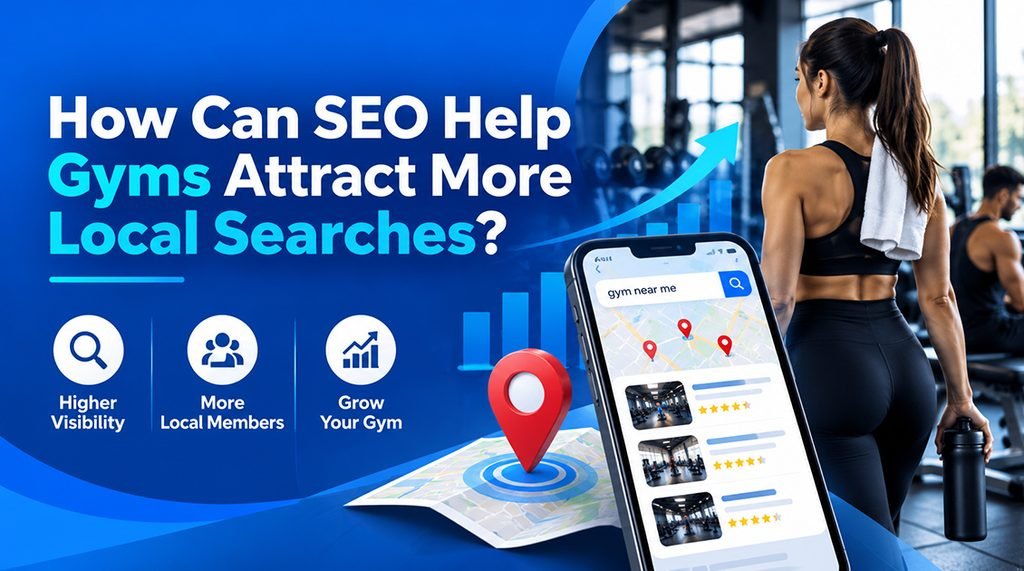
Search Engine Tuning for gyms can increase the visibility of fitness companies.
A potential customer, searching for” [term]” near me, [term]” for the [zip state zip code], or [term] near. Can have a requirement. Appearing high in search results can attract these customers to the website or business-profile.
SEO isn’t just about loading a page with keywords. There must be relevant useful content on the site that potential members are actually looking for.
Start With Gym-Focused Keyword Research
Keyword research can reveal the services, questions, and locations that matter to your audience.
For a gym, relevant search themes may include:
- gym near me
- fitness centre near me
- personal training
- strength training
- group fitness classes
- weight loss programmes
- fitness classes
- gym membership
- personal trainer
- gym for beginners
Field-specific changes may be usefully employed where appropriate. For instance, a gym can develop a relevant set of pages for its local area instead of trying to cover a wide geographical area.
It is not about duplication or throwing every keyword there is. The objective is about discovering what prospect members want and designing relevant pages based on the identified needs.
Strengthen Gym Local SEO
Creating a local presence is vital for many fitness businesses, as customers are often more concerned with proximity.
Begin with the Google Business Profile of the gym. Ensure that the name address contact number category hours of operation website images, and services info are consistent.
The photographs should be taken regularly and allow the future members to see the gym when they visit. Use genuine stock pictures of the actual gym trainers facilities and the gym equipment itself rather than the odd generic gym shot!
Reviews also play a part in local visibility and trust. Get real customers to review your service and reply politely to all reviews.
What Role Does Content Marketing Play in Gym Marketing?
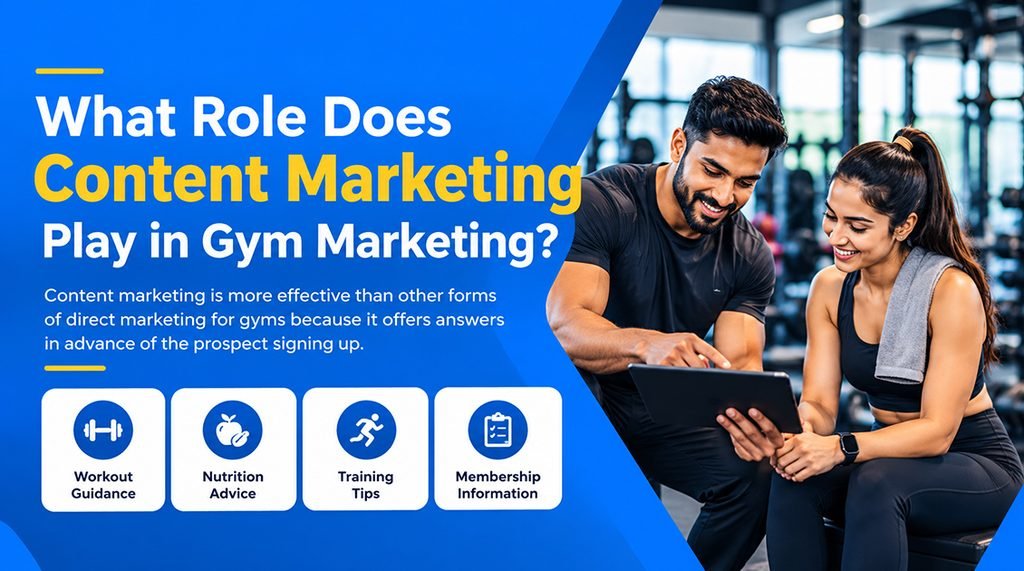
Content marketing is more effective than other forms of direct marketing for gyms because it offers answers in advance of the prospect signing up.
We can’t assume that people searching online are always looking for a membership straight away. People may have been looking for information about starting to exercise, deciding, which type of exercise to do, trying to learn more about nutrition or even asking for training advice.
A gym could publish content around topics such as:
- Beginner workout guidance
- Strength training basics
- Workout routines
- Fitness class explanations
- Training mistakes
- Recovery and mobility
- Personal training benefits
- Exercise equipment guides
- Questions about starting a fitness programme
The content should remain relevant to the services the gym actually provides.
Create Content That Supports Different Stages of the Journey
An article aimed at beginners might be appealing to someone still trying to understand the world of fitness. A section on your personal training services might appeal to a client who is weighing up options. A membership or trial section might appeal to someone who is already very near decision making time.
This creates a natural progression:
Educational content → Service information → Trust-building → Enquiry
Content must because of this do more than trigger traffic. It must begin to explain the business prospects and move them to the next suitable step.
How Can Social Media Marketing Help Gyms Attract Members?
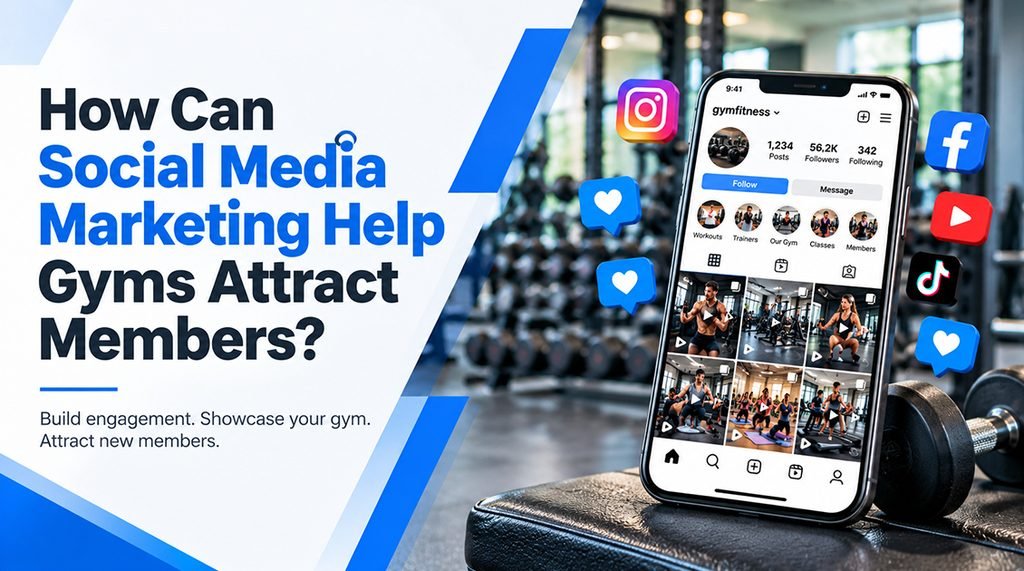
Gym social media marketing can be of greater use because fitness is a highly visual industry.
Show the Experience, Not Just Promotional Offers
A membership offer only can get boring after a while. A better mix of content can be info about the club, tour of the facilities, introduction of the trainers, a demo of some classes, tips for workout, FAQ’s, and truly community oriented content.
For example, a gym could use:
- Short exercise demonstrations
- Trainer-led educational videos
- Facility tours
- Class previews
- Equipment explanations
- Beginner tips
- Frequently asked questions
- Member-focused content where appropriate
- Limited-time offers when genuinely relevant
Build Trust Through Authentic Content
Reliable visuals and sensible explanations can help clear up some uncertainties.
Instead of selling a post every time, show the true experience a prospect will receive when they arrive.
When Should Gyms Use Google Ads and PPC Advertising?
The results of the organic marketing may take time to build up. Another way of reaching people who are interested in what you have to offer is through gym PPC advertising.
Another avenue that could also be used is Google Ads, which could steer potential gym-goers towards the website based on high intent searches, such as gym memberships, personal trainers, and local services.
But it may not be the best way to always take the paid visitor to the homepage.
When I click on a search engine ad for personal training I want to go to a page that is particular to the personal training sector, explaining what it is, the advantages, who it is for and how to get in touch.
Google Ads for Gyms vs Social Advertising
Different advertising channels can support different stages of the customer journey.
| Advertising Approach | Useful For | Example |
| Google Search Ads | Existing search demand | Someone searching for a nearby gym |
| Social advertising | Audience discovery and awareness | Promoting a new fitness programme |
| Remarketing | Reconnecting with previous visitors | Showing an offer to someone who visited a membership page |
If you get all these aspects right your campaign should work. The success of any campaign depends on targeting offer competition, quality of the landing page, budget, and tracking.
Before the time when you plan to allocate the ad spend, the enquiry path must be functioning properly.
Usual mistake: Send paid traffic to a general page and don’t tell people what to do next could mean that you won’t have a clue whether advertising getting leads means anything with results.
How Can a Gym Website Turn Visitors Into Enquiries?
Someone arriving on a gym website may immediately want to know:
- Where is the gym?
- What equipment is available?
- What classes are offered?
- How much does membership cost?
- Is personal training available?
- What are the opening hours?
- Is there a trial option?
- How can I contact the gym?
The answers should be easy to find.
Create Service-Specific Landing Pages
Why not also use separate pages for some of the key services rather than “crowding” it onto a single page?
For example:
Gym Membership Page: Describe membership options and facilities, and outline the main benefits of each type of membership; and briefly detail the enquiry process.
Personal Training Page: Describe how training is provided, what kind of people it is intended for and the best way to find out whether it is suitable.
Fitness Classes Page: Describe classes offered, schedules matched to certain abilities, and registration information.
Provided it is well-planned, this structure can be efficient and SEO-focused as on each page, you will better answer a more precise search intention.
Make the Conversion Path Simple
The ‘contact us’ section shouldn’t be several pages away from the other information of the website.
Depending on the business, useful conversion options may include:
- Enquiry form
- Phone call
- WhatsApp contact
- Trial booking
- Consultation request
- Class registration
Choose the actions that the gym can actually manage effectively.
How Can Email Marketing Help Gyms Nurture Prospects?
A simple nurturing sequence might include:
- A welcome message confirming the enquiry.
- Useful information about the gym and its services.
- Answers to common questions.
- Information about relevant classes or training options.
- A clear invitation to visit, book a trial, or speak with the team.
Existing members can also be provided with helpful communication for classes and events, new developments, training materials and offers.
It’s all about being helpful and helpful not being adding useless file after file in your contacts
Why Does Reputation Management Matter for Gyms?
Selecting a gym is at least partly a matter of trusting the establishment. Visitors to new gyms often scan reviews before visiting the premises, in particular when a number of fitness centers are competing nearby.
Gym reputation management means keeping an eye on what customers say in the feedback, replying in professional, and politely, manner, and to promote the customers to give feedback who is really consumed.
Should a good review process mean customers posting false or exaggerated reviews? Keep to real experiences.
Negative reviews are just feedback and should be able to be accepted and not hidden away. Respond positively and calmly, acknowledge the problem and try to rectify any operational issues arising.
Over the long run, a steady review profile tends to give prospects an idea of how current customers find it.
How Can Marketing Automation Improve Gym Customer Acquisition?
With an increasing number of inquiries, manual recording of all prospects can be a nightmare. Gym marketing automation can simply tidy up your communication and follow-up.
For instance, a gym might link the website admission forms with the CRM so that the new inquiries are stored in a central location.
A basic process could look like:
Website Enquiry → Lead Recorded → Immediate Confirmation → Sales Follow-Up → Nurturing → Visit/Trial → Membership
Lead information can also be organised according to the prospect’s stage.
For example:
- New enquiry: Has just submitted a form.
- Interested: Has responded or asked for more information.
- Visit booked: Has scheduled a visit or consultation.
- Trial stage: Has started a trial or introductory session.
- Member: Has completed the membership process..
What Should Gyms Measure in Digital Marketing?
A gym should connect its marketing metrics with actual business objectives.
| Metric | What It Can Help You Understand |
| Website traffic | Whether people are reaching the website |
| Organic traffic | Whether SEO is attracting visitors |
| Enquiries | Whether visitors are taking action |
| Qualified leads | Whether enquiries match the target customer |
| Conversion rate | How efficiently visitors become leads |
| Cost per lead | How much paid acquisition is costing |
| Trial bookings | Whether prospects are moving closer to membership |
| Membership conversions | Whether marketing contributes to actual customers |
| Email engagement | Whether subscribers interact with communication |
The specifics will be determined by the goals of the gym.
For example, a campaign, which attracts thousands of visits but a very small number of relevant enquiries might be quite different from one, which attracted a smaller number of visits but greater quality leads.
Measurement should so answer two questions:
What occurs?
and
Any ideas about what could be causing this?
That differentiation can enable you to make smarter decisions on your marketing as a gym owner instead of altering your efforts based on mention numbers.
A Practical 30-Day Digital Marketing Plan for a Gym
A gym does not need to launch every marketing channel simultaneously. A phased approach can make implementation easier.
Days 1–7: Build the Foundation
Start with the basic digital assets.
- Review the website and mobile experience.
- Check contact information.
- Improve important service pages.
- Update the Google Business Profile.
- Install appropriate analytics and tracking.
- Review existing customer reviews.
- Identify the main audience and business objectives.
Days 8–15: Strengthen Organic Visibility
Next, work on search and content.
- Research relevant gym and fitness keywords.
- Identify local search opportunities.
- Improve important website pages.
- Create useful fitness content.
- Review internal linking.
- Plan future content around real customer questions.
Days 16–23: Develop Lead Generation
Once the foundation is ready, consider paid and social channels.
- Identify suitable Google Ads opportunities.
- Improve social media content.
- Create service-specific landing pages.
- Test clear calls to action.
- Set up a simple lead-follow-up process.
Days 24–30: Measure and Improve
Review the events of the first few weeks.
Consider traffic enquiries, quality of leads, conversions behaviour and effectiveness of advertising where relevant.
Then see what aspects are lacking in the customer journey.
What you should aim for during the first 30 days is to implement a functional marketing system, not 10 new members.
Common Digital Marketing Mistakes Gyms Should Avoid
Focusing Only on Social Media
The social media part of a marketing strategy can increase awareness, yet it most likely cannot provide the full scope. Search, website conversion, local visibility, email, and lead follow-up have effects on the customer purchasing process as well.
Sending Everyone to the Homepage
All visitors have different needs. If they are looking for a personal training page and the service is provided, then they should be linked to that page instead of a generic one.
Ignoring Local Search
Where a gym is typically located in a known geographic area, neglecting search engine presence can make this easy-to-find business less visible to customers in the immediate vicinity.
Posting Without a Clear Purpose
Reliance on posting for activity alone makes posts repetitive. Every piece of content should be serving a specific purpose, be it to educate, resolve a query, establish trust, establish rapport, generate participation, or to enable an inquiry.
Failing to Follow Up With Leads
Only generating an inquiry is not enough for customer acquisition. In case of no quick reply, the customer may lose his interest and start looking for other options.
Frequently Asked Questions About Digital Marketing for Gyms
What is the best marketing media for a gym?
Every gym is different, your tactics need to be different. What’s right for your business will vary widely given your location, customers ‘ services you offer competitors’ budgets and goals. A blend of local SEO, a website built around conversions, content social media, paid advertising and constant follow up of leads should be tailored to meet every stage of your potential customer’s experience.
How can gyms drive leads online?
Gyms are getting new online leads from local SEO, Google Ads, social media advertising, content marketing, service specific landing pages, website enquiry forms and other digital channels. The key point is you need to tie them into a conversion path.
Is SEO good for fitness centres?
Yes. It can allow your fitness business to be found when searchers look for what you offer, where you are, or fitness related terms. Local SEO would be more important if your customers come to a place or location.
Is it worth it for a gym to spend on Google Ads?
Google Ads would be one of the options available if the gym wanted to target potential customers who were already looking for what they are offering. But, they would need to have everything else in place before running into it, i.e. Landing pages, offer, tracking, and lead follow up.
What level of investment should a gym make on digital marketing?
There is no such thing as a flat budget that is applicable to any gym as it will rely on the market competition, what’s your goal, the media, the content needs, the website needs, whether it is in house marketing or an agency. It is preferable to work within a budget based on a business goal and calculable customer acquisition costs, than applying a generic percentage.
How RG Startup Can Support Your Gym’s Digital Marketing
Having these SEO, paid advertising, social media content website optimisation, lead generation and marketing automation done by an internal marketing manager can take a lot of time and effort.
RG Startup may be marketed as a digital marketing partner for gyms and fitness businesses requiring assistance in any of these aspects.
Per the business requirement, the department can concentrate on gym marketing services SEO local search, content marketing, social media, paid advertising, website tuning, lead generation and marketing automation.
A proper strategy will initially require identifying the current digital presence of the gym, its target audience, business needs and current customer acquisition process.
If the gym is prepared to increase its online presence and create a more streamlined route from digital exposure to a customer enquiry, then a bespoke digital marketing strategy could be the natural next step.