Digital marketing can be defined as the marketing of a business, product, service, or brand using digital media channels to reach consumers. Digital marketing could include any number of content on a website, or email marketing, digital advertising or even search engine optimisation (SEO).
But digital marketing is not just posting a message to your social channels or advertising on Google. A digital marketing approach that makes sense ties various channels together and uses specific business goals. One customer can find your business through a search engine, go to your website, engage with your content and ultimately send you an enquiry or purchase.
Thus, visibility is not the only goal of digital marketing. Digital marketing also consists of the target audience, the right channels, the creation of relevant information, calls to action and the use of performance data for more marketing effectiveness.
Understanding the Core Idea Behind Digital Marketing
What is digital marketing? Digital marketing is the practice of marketing through digital channels, digital media and digital technologies. This includes marketing via a web-based platform, email, social media, applications, Search engine marketing (SEM), websites, digital content, as well as television and radio.
Various channels can also be used to attract different stages of the customer journey. Search engines are a great tool to let potential customers discover your business, content can be used to serve them the answers they are looking for, social media could be used to engage with them and email to maintain an engagement.
Digital Marketing and Online Marketing: Are They the Same?
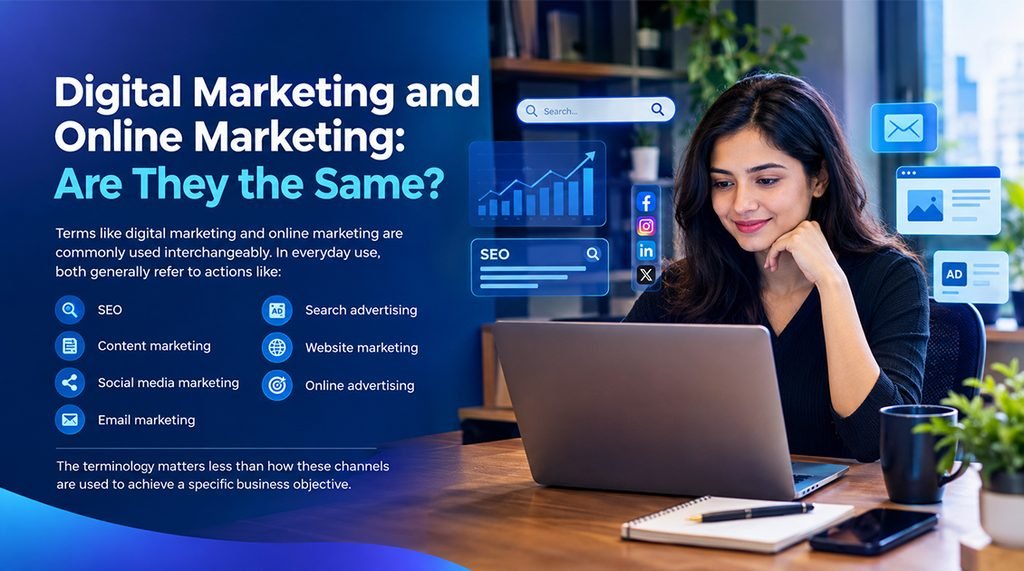
Terms like digital marketing and online marketing are commonly used interchangeably. In everyday use, both generally refer to actions like:
- SEO
- Content marketing
- Social media marketing
- Email marketing
- Search advertising
- Website marketing
- Online advertising
The terminology matters less than how these channels are used to achieve a specific business objective.
Why Digital Channels Matter for Businesses
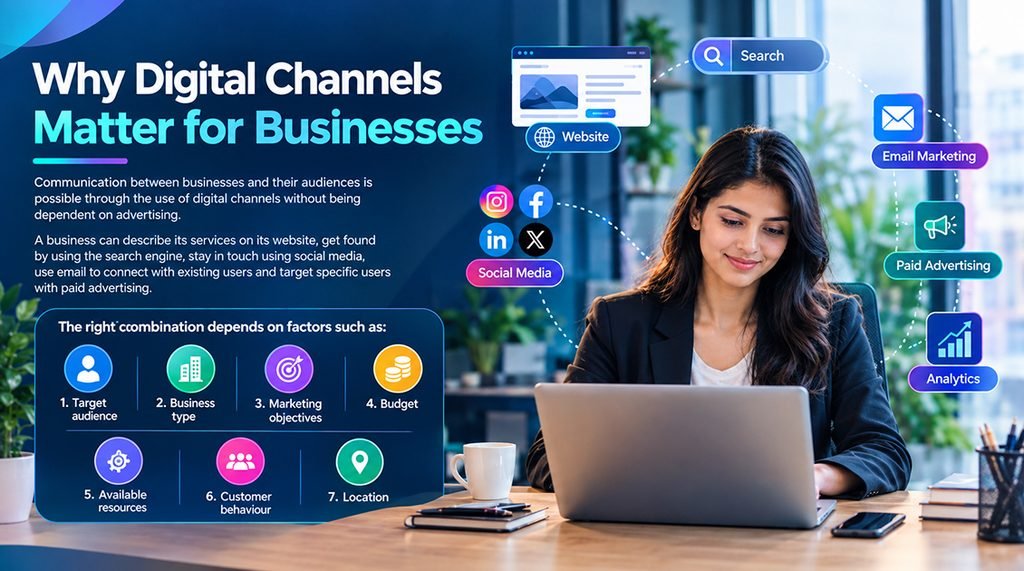
Communication between businesses and their audiences is possible through the use of digital channels without being dependent on advertising.
A business can describe its services on its website, get found by using the search engine, stay in touch using social media, use email to connect with existing users and target specific users with paid advertising.
The right combination depends on factors such as:
- Target audience
- Business type
- Marketing objectives
- Budget
- Available resources
- Customer behaviour
- Location
How a Digital Marketing Campaign Moves From Awareness to Action
The way digital marketing works is to establish a connection between the business and the right people at the right places at the right time to lead them to a desired action.
It may be subscribing to an e-mail list, visiting a web site, downloading material, requesting a quotation, booking a service, buying a product etc.
A simple way to understand the process is:
Attract → Engage → Convert → Retain
| Stage | What It Means | Examples |
|---|---|---|
| Attract | Help relevant audiences discover the business | SEO, content, social media, paid search |
| Engage | Help visitors understand the business | Website pages, guides, videos |
| Convert | Encourage a desired action | Enquiry, booking, sign-up, purchase |
| Retain | Continue the relationship | Email, follow-ups, useful content |
These stages are not necessarily sequential. A prospect may come to a website at first by an advertisement, visit it once, leave it for a while and then come back to it via a search engine, compare several offers and eventually make an inquiry.
Finding the Right Audience and Understanding Their Needs
A digital marketing strategy should begin by identifying the goal of the business.
Consider:
- Who may be the potential customers?
- What problems do they aspire to solve?
- What information do they need?
- Where do they search for information?
- What influences their decision?
- What could prevent them from taking action?
Turning Customer Interest Into Action
Getting a visitor to arrive at a website is just one aspect of digital marketing. The next stage is to allow the visitor to have a clear idea what they have to do.
Given the business, this could mean:
- Reading a relevant article
- Viewing a service or product page
- Downloading a guide
- Requesting more information
- Booking an appointment
Exploring the Different Areas of Digital Marketing
Digital marketing consists of several specialist channels. Businesses do not necessarily need to use every channel. The appropriate mix depends on the audience, objectives, resources, and customer journey.
| Channel | Main Purpose | Typical Activities |
|---|---|---|
| SEO | Improve organic search visibility | Keyword research, on-page SEO, technical improvements |
| Content Marketing | Educate audiences | Blogs, guides, videos, FAQs |
| Social Media | Build awareness and engagement | Posts, discussions, community interaction |
| PPC Advertising | Gain paid visibility | Search and social advertising |
| Email Marketing | Maintain relationships | Newsletters, offers, automated emails |
| Website Marketing | Inform and encourage action | Service pages, landing pages, forms |
| Local SEO | Reach local audiences | Listings, local content, reviews |
Search Engine Optimisation: Building Organic Search Visibility
SEO involves improving a website and its content so relevant pages can appear in organic search results.
It can include:
- Keyword research
- On-page optimisation
- Technical SEO
- Content optimisation
- Internal linking
- Website structure
Search engines can be valuable because users are often actively looking for information, products, or services.
Google’s SEO Starter Guide provides official guidance about helping search engines understand website content.
Start With Search Behaviour
- Keyword research helps a business have an idea of questions that people search online.
- For example, an accounting business may research terms such as:
- Accounting services for small businesses
- Small business bookkeeping
- Business tax help
- How to manage business accounts
These terms can then inform relevant website pages and content. Keywords should support the information rather than be inserted simply to increase frequency.
Making Local Search More Useful
Local SEO is particularly relevant for businesses serving a specific geographical area. Businesses can support local visibility by:
- Keeping business information accurate
- Maintaining consistent contact details
- Providing location-relevant information
- Making services and locations clear
- Encouraging genuine customer reviews
- Updating relevant online listings
Content Marketing: Answering Customer Questions Through Content
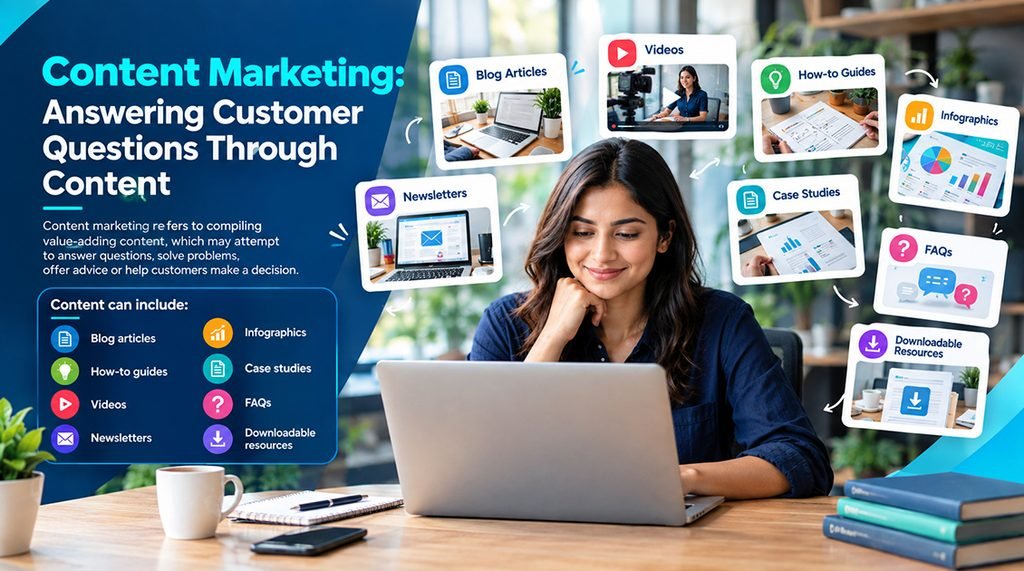
Content marketing refers to compiling value-adding content, which may attempt to answer questions, solve problems, offer advice or help customers make a decision.
- Content can include:
- Blog articles
- How-to guides
- Videos
- Newsletters
- Infographics
- Case studies
- FAQs
- Downloadable resources
We are not trying to publish everything; our content should answer true customer needs and should be part of a larger business goal.
Build Content Around Customer Needs
Before creating content, consider:
| Question | What to Establish |
|---|---|
| Who is it for? | Target audience |
| What do they need? | Problem or information requirement |
| Why are they searching? | Search intent |
| What should the content help them do? | Desired outcome |
| What should happen next? | Enquiry, subscription, or purchase |
Make Better Use of Existing Content
Existing content can sometimes be improved by:
- Updating outdated information
- Improving its structure
- Adding useful examples
- Strengthening headings
- Adding internal links
- Improving the call to action
- Aligning it more closely with search intent
This can make existing resources more useful without continually creating new pages.
Pay-Per-Click Advertising: Reaching Customers Through Paid Search
PPC offers businesses the ability to buy a presence on the internet. Search advertising can target when people are searching for specific keywords for example; social advertising can target by certain demographics.
PPC can give you visibility faster than organic SEO, but it still has to be managed.
Google Ads also explains how bidding and budgets work in paid advertising. Google Ads provides official information about bids and campaign budgets.
What Can Influence PPC Performance?
Results can be affected by:
- Audience targeting
- Keywords or search terms
- Ad copy
- Offer
- Landing page
- Budget
- Bidding strategy
- Conversion tracking
Email Marketing: Staying Connected With Existing Audiences
Email marketing is a direct way of communication with people who bought in or simply choose to receive communication.
It can support:
- Customer updates
- Newsletters
- Educational content
- Product launches
- Special offers
- Welcome messages
- Follow-ups
Make Email Communication More Relevant
Businesses can organise audiences according to:
- Interests
- Previous purchases
- Location
- Customer status
- Stage of the customer journey
Even simple segmentation can make communication more relevant.
Use Automation Where It Saves Time
Email automation can help manage:
- Welcome emails
- Scheduled newsletters
- Follow-up messages
- Customer reminders
- Post-purchase communication
Automation can save time, but messages should still provide useful and relevant information.
Social Media Marketing: Building Ongoing Customer Engagement
Social media can be used for awareness, customer communication, content distribution and engagement.
Yet this is not to say that there is a requirement for businesses to be present on all of them.
Choose Platforms Based on Your Audience
| Objective | Content Approach |
|---|---|
| Build awareness | Educational and visual content |
| Encourage engagement | Questions, discussions, community posts |
| Explain products or services | Demonstrations and informative posts |
| Share expertise | Industry insights and practical advice |
| Support local awareness | Community-focused content |
The question should be where the target audience is normally spending time and looking for new information.
Turn Customer Questions Into Content Ideas
Businesses can use customer conversations and feedback to identify useful topics, including:
- Frequently asked questions
- Common objections
- Repeated customer problems
- Topics generating discussion
- Products or services customers ask about
Organise Publishing With a Content Calendar
A simple content calendar can include:
| Content Category | Example |
|---|---|
| Educational | Tips and explanations |
| Product or service | Features and demonstrations |
| Customer-focused | Questions and common problems |
| Brand | Business updates |
| Promotional | Offers and launches |
What Makes Digital Marketing Valuable for a Business?
It allows the businesses to target and reach their customers in different ways and also to communicate effectively with them and could have a better understanding of their customers.
Firstly, it is measurable businesses can look at traffic to their website engagement lead generation, conversions, and several other indicators and gauge how well they are doing.
Digital channels offer a way to tailor communications to customers’ needs, by taking account of the customers’ interests, previous conversations, location, or stage in the buying process.
More traffic, followers, clicks, or published content do not necessarily result in better business performance.
Connecting Marketing Activity With Business Objectives
A useful strategy should answer three questions:
What are the objectives we want to reach?
And whom are we aiming at?
What sorts of things might we do to that end?
This ensures the attention remains on business results rather than a rise in marketing activity.
How to Build a Digital Marketing Plan From the Ground Up
1. Start With a Specific Business Objective
Possible objectives include:
- Increase qualified enquiries
- Generate more online sales
- Improve local visibility
- Build an email subscriber base
- Promote a new service
It becomes more useful when connected to a specific outcome.
2. Build a Clear Picture of Your Ideal Customer
Consider:
- Who are they?
- What problem are they solving?
- What information do they need?
- Where do they search?
- What influences their decision?
These answers can help determine the channels, content, and messages worth prioritising.
3. Match Marketing Channels to Your Goals
For example:
- SEO can support long-term search visibility.
- PPC can provide paid visibility.
- Content marketing can educate audiences.
- Email marketing can support relationships.
- Local SEO can help location-based businesses.
4. Develop Content That Serves a Purpose
A useful content process is:
Customer need → Useful information → Relevant solution → Clear next step
This connects content with the customer journey instead of treating content creation as an isolated activity.
5. Review Results and Adjust the Strategy
Businesses should regularly ask:
- Which channels attract relevant visitors?
- Which content receives meaningful engagement?
- Which pages generate enquiries?
- Which campaigns produce conversions?
- Where are potential customers dropping out?
The answers can guide future optimisation.
Digital Marketing Metrics Businesses Should Track?
The most relevant metrics depend on the purpose of the marketing activity.
| Metric | What It Helps Understand |
|---|---|
| Website traffic | Number and sources of visitors |
| Organic traffic | Search-driven visibility |
| Click-through rate | Response to links or advertisements |
| Engagement | Audience interaction |
| Leads | Potential customers generated |
| Conversion rate | Percentage completing an action |
| Customer acquisition cost | Cost associated with acquiring customers |
| Revenue | Financial outcome |
| ROI | Value generated compared with investment |
Looking Beyond Traffic and Engagement
Traffic and engagement may be good indicators, but they shouldn’t always be considered as success of the business.
A business that is lead-generation driven might deem a qualified enquiry to be important, more important than a visitor. Whereas a transaction driven business (such as an ecommerce shop) might prioritise transactions and the return on investment (ROI) from those transactions.
The right metric is therefore determined by the objective of the activity.
Understanding Digital Marketing ROI
Digital marketing ROI considers the value generated by marketing in relation to the resources invested.
Different channels can also operate over different timeframes.
| Activity | Key Consideration |
|---|---|
| SEO | Visibility can take time to develop |
| Content marketing | Value can build as useful content accumulates |
| PPC | Provides paid visibility while campaigns are active |
| Email marketing | Value can develop with subscriber relationships |
| Social media | Can support awareness and engagement |
Digital Marketing Challenges Businesses Should Be Prepared For
Avoiding the Pressure to Be Everywhere
Using all channels may scatter limited time and resources. Organizations should focus on channels that are most relevant to their customers and themselves.
Creating Content Without a Clear Purpose
If you publish just to help publishing then it can be a waste of money and time. Publication needs to be purpose driven and needs to lead to an outcome. Content needs to answer a question, solve a problem or guide a decision.
Measuring Activity Instead of Business Results
Numbers of followers, page views and published articles can be valuable indicators, but need to be related to results like enquiries, sign-ups, purchases, or income where possible.
Treating Digital Marketing as a One-Time Campaign
Digital marketing is not a one-time campaign. You can study the progress of your campaign and modify your content targeting messaging, channels, and budget.
Digital Marketing FAQs
What exactly is digital marketing? Answer in brief.
Digital marketing refers to the promotion of a business, product, service, or brand using digital channels such as websites, search engines, social media, electronic mail content, paid advertising etc.
How can digital marketing boost business growth?
What can it do for businesses? It can then assist businesses in finding target audiences, raise awareness of the business, create enquiries or sales, communicate to their customers and measure the success of marketing activities.
What channels does digital marketing encompass?
Popular channels would be SEO, content marketing, social media marketing, PPC email marketing, marketing website and local SEO.
But, businesses are not required to make use of every single point.
Are Small Businesses able to Leverage Digital Marketing?
Yes. The digital marketing element can be easily scaled up or down based on the business, target audience, aims, and budget. A small business may want to start off with a narrow selection of channels rather than trying to jump in head first.
What is the distinction between SEO and PPC?
Search engine tuning (SEO) is using search engine improvement techniques in order for a website to appear higher for specific keywords in the search engine listings, while pay-per-click (PPC) is paying for advertising and appearing higher in the listings.
How much time is taken by digital marketing to start delivering results?
No one time frame. Things like SEO and content marketing will require time before visibility is achieved and paid advertising can have traffic within minutes after campaigns are live.
Final Thoughts on Building a Practical Digital Marketing Strategy
Digital marketing is a marketing strategy used by the enterprise to communicate with its prospective customers and each type of marketing activity, which takes place through the internet channels.
The practical approach: Starting from the business goal and customers, and not from a list of channels. You can identify what channels are suitable for your business and develop suitable content.
Focused on authentic customer needs, track relevant outcomes and optimize their strategy through learning.
The goal is not to be all over the place. Rather, the goal is to be visible in the places where the right prospects are looking, to speak to them that gives them what they need to make a decision, to make a call to action clear, and to use the results to continually refine.