For a small business, digital marketing may not be about having a presence on all the sites, producing a piece of content every day or high spending on advertising. It is about understanding where your customers will be searching, and what you need to communicate to them, in as many marketing activities as feasible to satisfy the business objectives.
Establish awareness while driving relevant visitors, increasing leads and eventually closing sales. The key focus should be customer centric rather than digital channel centric.
A useful approach inevitably moves to the fundamentals like: establish your objectives; identify your audiences; organize your site; select the channels; develop needed content; and analyze what has proven to work.
What is digital marketing all about for Small Business?
Digital marketing is the promotion of products or services using digital channels to reach consumers. For a small business, this may involve using a website, search engines, social media email content marketing, and online paid advertising.
The key thing is that digital marketing is not one activity. Digital marketing channels could be used in different ways.
| Digital Channel | Primary Purpose | How It Can Help a Small Business |
| SEO | Search visibility | Help potential customers discover the business |
| Local SEO | Local discovery | Reach people searching for nearby products or services |
| Content marketing | Education and awareness | Answer customer questions and build trust |
| Social media | Engagement and awareness | Build relationships and maintain visibility |
| Email marketing | Nurturing | Stay connected with interested customers |
| Paid advertising | Targeted acquisition | Reach people with relevant offers or searches |
| Website | Information and conversion | Explain the business and encourage enquiries |
Like I said, no single approach is always superior; the perfect blend will definitely vary based on the type of business, target customer and available resources and objectives. Your online marketing manual also emphasizes that content and a suite of additional digital tactics will integrate (not operate in segregation) toward providing a comprehensive customer path.
Start With the Basics: Goals, Audience and Budget
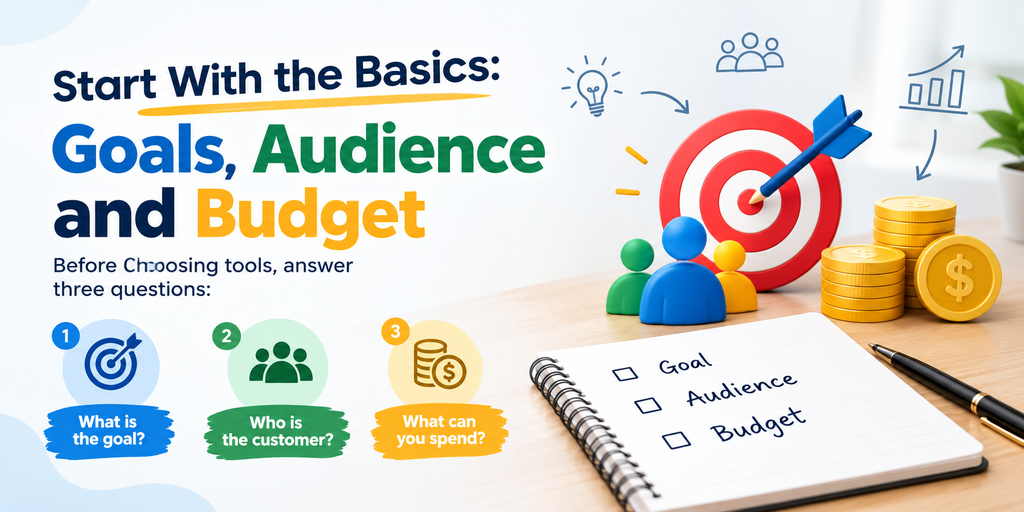
Before choosing tools, answer three questions:
- What is the goal? Calls, form enquiries, bookings, store visits or online sales. Pick one primary goal.
- Who is the customer? Age, location, problems, and where they look for answers.
- What can you spend? Both money and hours per week. A realistic plan you can sustain beats an ambitious plan you abandon.
Clearly identify your channel – what do you want digital marketing to do?
For example, your goal might be to:
- generate more enquiries
- increase local visibility
- attract qualified website visitors
- promote a new service
- increase online sales
- build an email list
- improve repeat customer engagement
Goal: Having a goal is vital because it will provide some direction to all marketing activities. If not this will just be a matter of counting numbers of followers hits articles published without understanding if they are supported by the business goal.
Know Who You Are Trying to Reach
A small business does not necessarily need to reach everyone.
Identify:
- Who is your ideal customer?
- What problem are they trying to solve?
- What do they search for online?
- What questions do they ask before purchasing?
- What concerns might stop them from contacting you?
- Which platforms or channels do they already use?
How can their technology really support those small businesses?
Before you go all in to marketing, ensure the nuts and bolts are in place.
Your website should clearly communicate:
- what the business offers
- who it serves
- where it operates, if location matters
- why customers should consider it
- how customers can contact the business
- what action visitors should take next
A Simple Website Readiness Checklist
- Clear homepage message
- Service or product information
- Easy-to-find contact details
- Clear calls to action
- Mobile-friendly experience
- Relevant landing pages
- Useful customer information
- Analytics and conversion tracking
Your website should not just be an online brochure, but an aid that moves your visitors toward the next step – whatever that may be.
Take for example, instead of putting every service on a generic page, say a local home improvement company; they could have separate pages covering: full home renovation, kitchen remodeling, bathroom remodeling.
So, the more a visitor uses the website and the more the search engine learns what the content of each page really is.
How Can Small Businesses Leverage SEO?
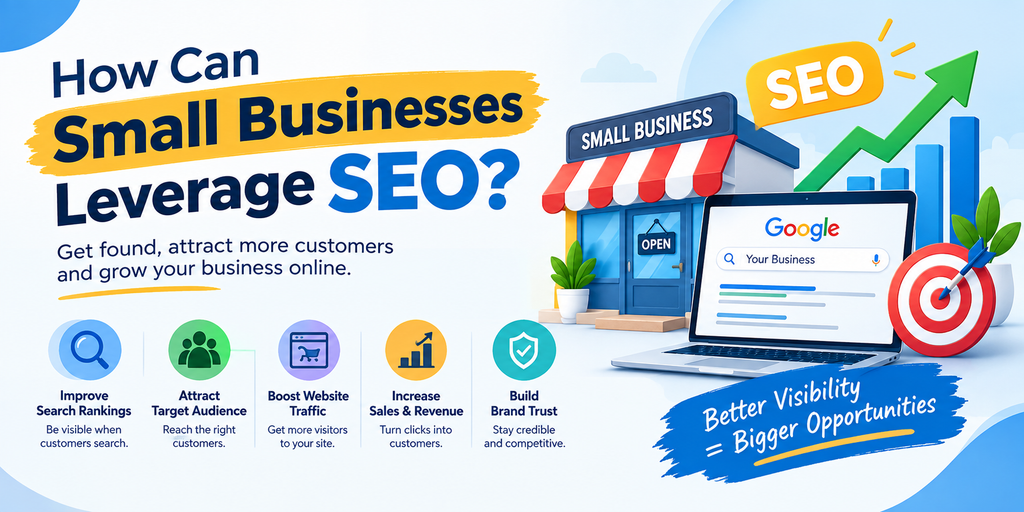
SEO can help small businesses get seen when customers are looking for the products, services, answers, and solutions you offer.
The aim is not to put in as many keywords in as possible. Put the other way round and search for what the searcher is actually trying to do.
Start With Keyword Research
The purpose of Keyword research is to find the words and phrases that people tend to search.
For example, a local bakery might discover searches such as:
- bakery near me
- birthday cakes near me
- custom cakes
- wedding cake bakery
- eggless cakes
- cake delivery in [location]
Build Pages Around Search Intent
Different searches can represent different needs.
| Search Type | Possible User Need | Useful Content |
| “what is SEO” | Learning | Educational guide |
| “SEO services for small business” | Evaluating providers | Service/comparison content |
| “SEO agency near me” | Finding a provider | Local/service page |
| “how to improve Google ranking” | Solving a problem | How-to guide |
| “SEO pricing” | Evaluating cost | Pricing/buyer guide |
Make Local SEO Part of the Strategy
For businesses serving a specific area, local search can be especially important.
Focus on making essential business information accurate and consistent, creating location-relevant content where useful, and making it easy for potential customers to understand:
- where you operate
- what you offer
- how to contact you
- what areas you serve
Local SEO should help the right nearby customer find the right information, rather than simply trying to increase traffic from everywhere.
Can Small Businesses Succeed With Content Marketing?
Yes, but you should not consider content marketing as a race to generate the most number of articles.
Taking the stronger line requires us to produce content which tackles genuine customer questions and issues.
Content marketing is bigger than blogging. Content is there to give prospects what they need to know in every step of the sales process with TOFU content going to create awareness, MOFU for evaluation, and BOFU for consideration.
Plan Your Content Before Getting Started
Start by identifying the questions customers ask.
For example, a small accounting firm could create content around:
- How much does bookkeeping cost?
- What records should a small business keep?
- When should a business hire an accountant?
- What is the difference between bookkeeping and accounting?
- How can a small business prepare for tax season?
This creates content around actual customer needs rather than publishing random topics.
Evaluate Your Existing Content
Before creating something new, Ask:
- Which pages receive traffic?
- Which articles generate enquiries?
- Which topics receive engagement?
- Which pages are outdated?
- Which important customer questions have not been answered?
Sometimes improving an existing useful page is more practical than producing another similar article.
Reach Customers Through the Right Channels
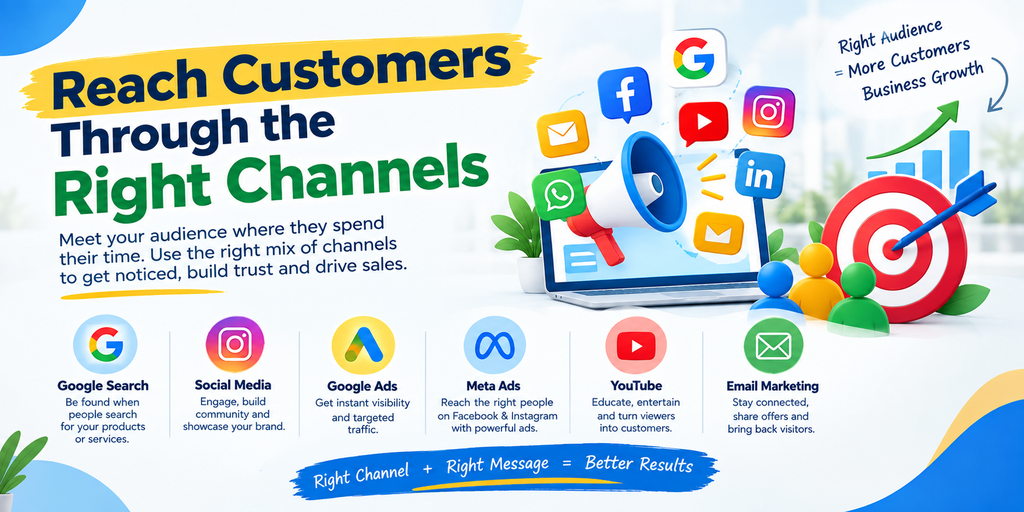
Based on the business, useful distribution channels might include. Could be that the small business content plan does not plan enough.Devise a realistic schedule and don’t expect to publish dozens of times in a single day.
- website
- Google search
- social media
- industry communities
- local platforms
You do not need to use every channel.
Track and Evaluate Content Performance
Content performance can be evaluated through signals such as:
- visits
- engagement
- enquiries
- conversions
- assisted conversions
The purpose is not simply to discover which article received the most traffic. It is to understand which content is contributing to the business objective.
How Can Small Businesses Use Social Media Marketing?
Focus on the Platforms Your Customers Use
Do not feel pressured to maintain five or six social profiles.
Consider:
| Business Situation | Potential Focus |
| Visual products | Instagram, Pinterest, visual content |
| Professional B2B service | LinkedIn, educational content |
| Local service business | Facebook, Instagram, local content |
| Video-led business | YouTube, short-form video |
| Community-driven business | Facebook groups/community channels |
The specific platform should depend on where your customers actually spend time.
Understand Your Customers Better
Social media can also function as a listening channel.
Pay attention to:
- recurring questions
- complaints
- customer language
- product requests
- common misconceptions
- topics generating discussion
Such learnings can be used for design of subsequent content, offers, and communications to customers.
Create a Manageable Content Calendar
Small businesses can struggle because their content plan is too ambitious.
Come up with an achievable schedule rather than trying to publish dozens of times a day.
For example:
| Day | Content Type | Purpose |
| Monday | Educational post | Answer a customer question |
| Wednesday | Product/service post | Explain an offer |
| Friday | Example or customer-focused post | Build trust |
| Weekend | Community/engagement content | Encourage interaction |
Consistency that can actually be maintained is more useful than an unrealistic publishing schedule.
Engage With Customers
Social media should not become a one-way broadcasting channel.
Respond to relevant:
- questions
- comments
- concerns
- messages
- feedback
What Is the Right Approach to Email Marketing for Small Businesses?
Email can help a small business stay connected with people who have already shown interest.
The first step is building a permission-based subscriber list.
Build and Grow Your Email List
Potential ways to encourage subscriptions include:
- useful guides
- newsletters
- downloadable resources
- discounts where appropriate
- educational content
- event registrations
- relevant offers
The offer should provide a genuine reason for someone to subscribe.
Use Automation for Repetitive Tasks
Automation can help with repetitive communication such as:
- welcome emails
- reminders
- follow-ups
- customer education
- re-engagement
- scheduled campaigns
The important point is that automation should make communication more useful, not simply increase the number of emails being sent.
Create Emails That Are Easy to Read
Keep the message focused.
A useful email should generally make it clear:
- Why the recipient is receiving it
- What the message is about
- Why it matters
- What they should do next
Keep mobile readability in mind and avoid filling the email with unnecessary information.
Personalise Within Your Budget
For example, an online store might separate subscribers based on:
- previous purchases
- product interests
- location
- customer stage
That allows the business to avoid sending exactly the same message to everyone.
Highlight the Offer and Its Value
Promotional emails should explain the value of the offer rather than simply saying:
“Buy now.”
Explain:
- what is being offered
- who it is for
- what problem it addresses
- what benefit it provides
- what the recipient should do next
How do I decide when I should start paid advertising for my small business?
Paid advertising may result in faster exposure but it should not be the first thing attempted.
Before spending money, make sure the business understands:
- its target audience
- its offer
- its landing page
- its conversion goal
- its budget
- how results will be measured
A simple advertising path might look like:
Ad → Relevant Landing Page → Clear Offer → Conversion
If the advertisement promises one thing but the landing page discusses something completely different, the customer experience becomes weaker.
Match Advertising to Customer Awareness
An unknown entity to you might require education and leveraging of trust.
There are searchers who are already looking for a particular service.
So this is one more reason not to treat all visitors and prospects equally.
How Can Small Businesses Measure Digital Marketing Success?
One of the worst things a small business can do is to count activity rather than results.
Publishing is an activity, that’s publishing ten posts.
What is the business outcome for receiving qualified enquiries from those posts?
The analytics principles in the guide highlight 1) giving data a job, 2) tapping hypotheses to turn questions into strategies, and 3) understanding context before interpreting.
Focus on Key Digital Marketing Metrics
The right metrics depend on the objective.
| Business Goal | Useful Metrics |
| Increase visibility | Search visibility, relevant traffic |
| Generate leads | Enquiries, conversion rate, qualified leads |
| Increase sales | Purchases, revenue, conversion rate |
| Improve website performance | Conversion rate, landing-page performance |
| Improve email marketing | Opens, clicks, conversions |
| Evaluate paid advertising | Cost per lead, conversions, revenue/ROI |
Do not track every number simply because a platform provides it.
Start with the business goal and work backward.
Ask Why, Not Just What
Suppose website traffic increased by 30%.
The next question should be:
Why did it increase?
Possible explanations could include:
- a successful campaign
- seasonal demand
- improved search visibility
- social media activity
- external events
- a new content piece
- changes in measurement
A Simple 30-Day Digital Marketing Plan for Small Businesses
If you are starting from scratch, do not try to launch everything at once.
Days 1–7: Build the Foundation
Focus on:
- defining your main business goal
- identifying your target customer
- reviewing your website
- checking contact and conversion paths
- identifying your main competitors
- beginning keyword research
Days 8–15: Improve Search and Content
Focus on:
- improving important website pages
- identifying useful content topics
- creating one or two high-value resources
- addressing important customer questions
- reviewing local SEO if relevant
Days 16–23: Build Reach
Choose one or two appropriate channels.
For example:
- social media
- local search
- paid advertising
Do not attempt to master everything simultaneously.
Days 24–30: Measure and Improve
Review:
- website traffic
- enquiries
- conversions
- content engagement
- search visibility
- advertising performance, if applicable
Then ask:
What is working, what isn’t, and what do I need to test next?
The more general approach also suggests that you set individual tactics, monitor how they perform and then optimize rather than everything being done and dusted.
Common Digital Marketing Mistakes Small Businesses Should Avoid
Trying to Be Everywhere
Having an active online presence on all the channels could overextend a small team.
Select the channels per the audience and objectives.
Publishing Without Knowing the Purpose
There should be a purpose behind a blog post, social post or an email.
Identify its purpose in the customer journey.
Focusing Only on Traffic
The traffic is helpful but does not necessarily translate into the growth of business.
Check enquiries, conversions, customers, and revenue as relevant.
Using Too Many Keywords
There is a call to improve SEO principles without compromising the flow of the writing.
Writing is for people first.
Ignoring Existing Customers
Digital marketing is not only related to customer acquisition.
Useful content, social interactions and communication, as well as email, will continue to forge relationships beyond the initial purchase.
Expecting Immediate Results From Every Channel
Various channels have different timelines.
These different channels of communication should not all be expected to perform at the same level. Seo content email, social media and paid advertising.
Digital Marketing for Small Businesses: Frequently Asked Questions
What Is Digital Marketing for Small Business?
The utilization of digital media channels, including websites, search engines, social media, email, content, and online advertising, to engage with consumer prospects and current customers.
Why is digital marketing so crucial to small businesses?
Offers a means for small businesses to be found, tell customers about themselves, create inquiries and track some of their marketing effort. Which method is the most appropriate will vary per the target market objectives, resources and customer process.
What are the most effective digital marketing tools and strategies available for small businesses?
Every small business is different. One method may fit for one business but may not for another. Search engine tuning, local search improvement, content marketing, social media, email marketing, and pay-per-click advertising all can serve a different purpose.
What are ways for small businesses to get online visibility?
Starting with a relevant website, familiarising with the concepts of related query, producing content that meets the needs, optimizing the key pages for broader coverage, applying local SEO on the pertinent pages and keeping the suitable online channels where the customers are engaging.
How Much Time Does it Take for Digital Marketing to See Results?
Different timelines apply according to the channel, the industry, current competition, starting position and how good the implementation is. Some paid campaigns can stir up activity quite quickly, still the sum of SEO and content tends to be working for quite long. Don’t assume a set number of days is a promise.
When do Small Businesses need to Employ a Digital Marketing Agency?
It varies on theIn-house preferences/in skills/time/ budget and necessity for the business. Some businesses are capable of running some stuff themselves and some benefit from outsourcing the website operation for SEO content, paid advertising, or analytics.
Final Takeaway
Start small with your digital marketing strategy for your small business. Here’s how to take your small business digital marketing as far as you want to go.
Start with the mission. Know your customer. Build a strong, appropriate foundation and then pick the channels that support the mission.
Leverage SEO and content to answer questions for customers, social media for the right connections, email for warm leads, and paid when you need to reach in a more targeted way faster.
Most importantly, focus on the long-term, digital marketing is an iterative process:
Plan > Check> Act >Repeat.
When it comes to small companies that require assistance with the selection of the most appropriate channels, or require support in specific digital marketing activities, RG Startup can be used as an optional external support given the demands of the business.
The concept is quite simple: you don’t have to do everything. You just have to do the right things for the right age segment at the right stage, and keep on optimizing them according to what the data and customers are telling you.