For most of the hotels and hospitality businesses, the customer journey starts well before the guest has arrived onto the property. Booking research for a business or leisure trip to the area can be done by simply searching online for the destination, browsing through hotels and browsing reviews on the areas using images and comparing room rates and facilities before the guest has even stepped onto the property. Such is the importance of digital marketing for hospitality.
Simply having plenty of appealing photographs of hotel rooms on its website and launching the odd pay per click advertising campaign is not an effective strategy in the modern hospitality arena. The hospitality company should be found by potential visitors; clearly communicate the attributes of the business, build, and develop brand confidence and then influence the reader to perform the desired actions on the site and offline.
This booklet describes how hotels resorts restaurants, travel accommodation providers and other businesses in the hospitality industry can use search engine improvement (SEO), local search content social media, paid advertising, email marketing and automation to create a more successful online marketing structure.
What is the implication of digital marketing on hospitality companies?
Hospitality digital marketing is the usage of online platforms to attract the guest through online advertisement for hospitality services, direct booking and maintaining relation with customers.
A hotel would want to utilise the likes of search engine optimisation, Google Business Profile, social media, paid advertising, email campaigns, online reviews and their own website. A resort may want to look at destination content, visual storytelling, seasonal campaigns and experience based marketing too.
Second, what is crucial is that these channels should be integrated.
For instance a traveller will search for the hotel on Google, explore the hotel’s website (maybe to compare hotel rooms), explore the hotel’s Instagram account (for pictures), read the reviews and then through paid advert again book the hotel. If all the channels gave a consistent experience then the business stands a greater chance of being considered.
So, hotel online marketing should be seen as a full customer journey instead of one bunch of stand alone promotions.
The Main Digital Channels for Hospitality
| Channel | Primary purpose | Typical hospitality use |
| SEO | Organic visibility | Hotel, destination and service searches |
| Local SEO | Local discovery | Maps, directions, nearby searches |
| Content marketing | Education and engagement | Travel guides, destination content |
| Social media | Awareness and visual discovery | Rooms, experiences, events |
| Paid advertising | Targeted traffic | Hotel offers and booking campaigns |
| Email marketing | Retention and nurturing | Offers, confirmations, guest communication |
| Website marketing | Information and conversion | Room pages, amenities, bookings |
| Reputation management | Trust | Reviews and guest feedback |
| Marketing automation | Efficiency | Follow-ups, segmentation and personalised campaigns |
The right combination depends on the property, location, audience, seasonality and commercial objectives.
How Does the Hospitality Customer Journey Work?
Few hospitality customers will place a booking upon first contact with a single piece of marketing. Their process continues through many procedures.
A traveller planning a trip might first of all look for things to do, then later on might search for hotels, look at locations, look at room types and read reviews. But a very busy business traveller might search a whole lot more directly for the hotel next to the business district or event venue.
So a hospitality business needs content and marketing activities for differing stages of their customers’ decision-making process.
From Destination Discovery to Booking the journey can broadly move through four stages:
Awareness:The traveller encounters a destination, hotel, experience, or hospitality brand.
Consideration:They compare accommodation, types, locations, prices, facilities, reviews, and experiences.
Decision:They verify availability, look into deals and determine to agent or book directly, or..
Post-booking and retention:It extends over pre-arrival communication, through the stay itself, and post-stay intervention, review, and other products offers.
This is an interesting implication for hospitality marketing. It would be wrong for a business to have the same message for a person who just found the destination and a person who is comparing room options.
Information about the destination may suit one person. A comparison of a room or special deal may be more useful at an earlier stage.
How Can SEO Bring Hotels and Hospitality Businesses to Be Found?
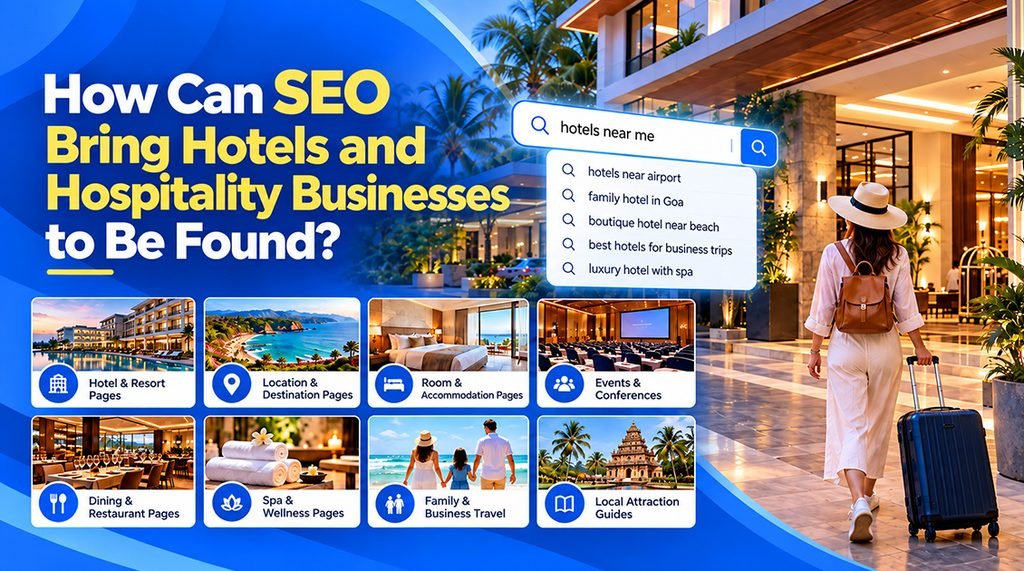
The hospitality SEO is optimizing your business to be listed when potential guests search for hotels, destinations, attractions, conferences, accommodation, and entertainment. Following Google’s own SEO Starter Guide is a good way to get the basics right, and a professional SEO company can help you scale results faster.
Search behaviour in hospitality can be extremely specific. A traveller, at any given stage of their search, might search for ‘hotels near airport’, ‘family hotel in [destination]’, ’boutique hotel near [area]’, or ‘best hotels for business trips’.
This opens up opportunities other than ranking for the hotel name itself.
Build Pages Around Guest Search Intent
Have valuable pages on the services and experiences that matter to your audience.
Depending on the business, this could include:
- Hotel or resort pages
- Individual room pages
- Location and destination pages
- Event and conference pages
- Restaurant or dining pages
- Spa and wellness pages
- Wedding and celebration pages
- Family or business travel information
- Local attraction guides
- Frequently asked questions
The objective is not to create pages simply because a keyword exists. Each page should provide information that matches what the visitor is actually trying to find.
For instance, a hotel is close to an airport and a guest is interested in travel distances, photo’s, check-in times, parking and room facilities. A vacationer interested in a family holiday resort and a guest might be more interested in room configurations, activities , dining and local sites.
Use a Content Structure That Supports SEO
- A hub and cluster model can also be used.
- A primary direct page may include links to complementary content including guides to local attractions, travel planning, weather, and facility-specific pages.
- This helps build a more useful internal linking structure but still gives search engines additional context for the business and what it’s relevant to..
Why Is Local SEO Important for Hospitality?
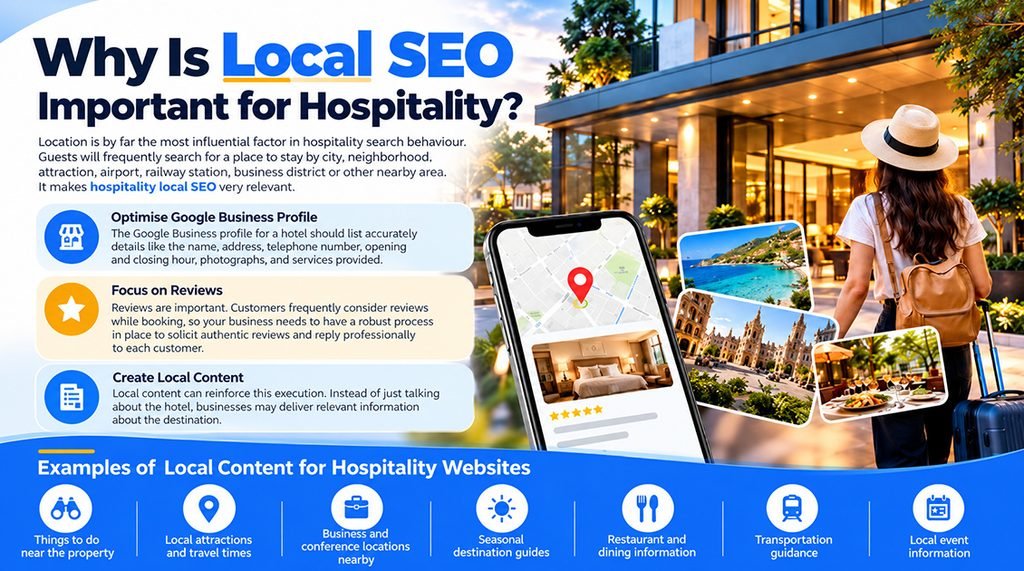
Location is by far the most influential factor in hospitality search behaviour. Guests will frequently search for a place to stay by city neighborhood attraction, airport railway station, business district or other nearby area.
It makes hospitality local SEO very relevant.
The Google Business profile for a hotel should list accurately details about the hotel like the name address telephone number, opening, and closing hour, photographs, and services provided.
Reviews too are important. Customers frequently consider reviews while shopping and so your business needs to have a robust process in place to solicit authentic reviews and reply professionally to each customer.
The local content can reinforce this execution. Instead of talking about the hotel, business may deliver relevant info about the destination.
For example, a hotel website could publish:
- Things to do near the property
- Local attractions and travel times
- Business and conference locations nearby
- Seasonal destination guides
- Restaurant and dining information
- Transportation guidance
- Local event information
How Can Hospitality Content Marketing Attract Potential Guests?
Hospitality content marketing is most powerful when it helps travel buyers to Google the destination, plan a visit, and experience it.
The hospitality sector has this as a natural strength because the decisions to travel are a part of it are shaped by experience. People are required to understand a feel of a location, the actions available there and the concept of their visit.
A hotel can respond to questions that the guests may have.
Focus on Information Guests Actually Need
A content strategy that could be put in place would be destination guides, travel tips, local experiences, seasonal recommendations, events, and hotel specific information.
For instance a hotel resort might prepare a brochure informing families on how to organize a weekend visit to the regions in the proximity. Then again, a business hotel can issue a leaflet or a brochure about the business areas, exhibition halls, and transport stations around.
Content should not always have a sales related message.
A reader that discovers a helpful destination guide, may not convert straight away. But, it can help evangelise the brand while the reader is still in research. Then he or she may pop back to the site at the moment of purchase.
Combine Written Content With Visual Experiences
Hospitality is a very visual subject, so should not be solely reliant on podcasts as article reading.
The images featured in photograph, room videos and all relevant videos including short-form videos, virtual tours, restaurant images, event photography, and destination videos all help prospective guests understand the experience before booking.
Then, the content can be shared by social networks.
Authenticity is everything. All pictures and videos should truly represent the property and the experience rather than providing exiguous notions to the visitors of what the actual guest experience would be like.
How can Hotels Use Social Media Marketing?
Hospitality social media marketing is more than just showcasing a room image and a booking link.
It can also give hospitality businesses the opportunity to attract customers and promote the experience of staying at their hotel.
Create a Balanced Hospitality Social Media Strategy
For example:
The property and experience content displays rooms, facilities , restaurants , pools , events, etc.
The content of your destination may bring in local points of interest, activities, and seasonal activities.
Travel tips include answering travel questions and providing a plan.
Content that appeals to your visitors can include authentic experiences, testimonials, and reviews.
Promotional contents may deliver information on packages, seasons, and events.
It also has to influence the form. Instagram and Facebook are more appropriate for visual stories, whereas for example LinkedIn will be more for hotels where business events and travels are concerned.
The aim is to establish a digital identity that people can identify with rather than bombarding them with advertising on a daily basis.
When Should Hotels Use Google Ads and Paid Advertising?
Paid visibility although a hospitality venue doesn’t necessarily need paid visibility, it can be used to find a specific market or advertise a special edition of a package.
Google Ads for hotels can be focused on searches where users are actively searching for somewhere to stay. Campaigns can be set up based on locations, property types, travel requirements or specific amenities.
Meta advertising can delve into a more discovery-driven approach and use images and videos to bring your houses and offers before targeted audiences. For professional campaign management, you can also explore digital marketing services.
Match the Campaign With the Customer’s Intent
When I want to find a particular hotel, I know what I want. When I am looking at travel shows on social media, I may already be considering several but I am still considering.
The advertising message should reflect this difference.
| Audience situation | Suitable approach |
| Searching for accommodation | Search-focused advertising |
| Comparing properties | Property benefits and differentiators |
| Exploring a destination | Visual and destination-led advertising |
| Visited the website | Retargeting and relevant reminders |
| Existing customer | Offers, loyalty and repeat-stay communication |
An important point here is the landing page.
If an ad is advertising a specific hotel package, room type, or event, sending users to an index page can often add needless steps. A targeted landing page should deliver what was spoken about in the ad and also make the next step obvious to the end-user.
How Can a Hotel Website Turn Visitors Into Bookings?
A hotel’s website should do more than display photographs and contact information. It should help visitors make a decision.
A potential guest may want to know:
- What room options are available?
- What facilities are included?
- Where is the property located?
- How far is it from important places?
- What dining options are available?
- Is parking available?
- What experiences or services are offered?
- How can the guest make an inquiry or booking?
The answers should be easy to find.
Build Clear Paths to Conversion
A visitor should not have to go through multiple pages to locate the booking form once he/she is ready to purchase.
On a similar note, a researcher may need a little more information before jumping in.
Useful conversion paths can include:
Explore → Compare → Enquire → Book
Or, for a less committed visitor:
Read Guide → Explore Property → View Rooms → Consider Booking.
This is where hotel website marketing and conversion optimization go hand-in-hand. The site should cater for various stages of customer intention rather than posing as if all visitors are also intending immediately to click through to booking.
How Can Hospitality Businesses Use Email Marketing?
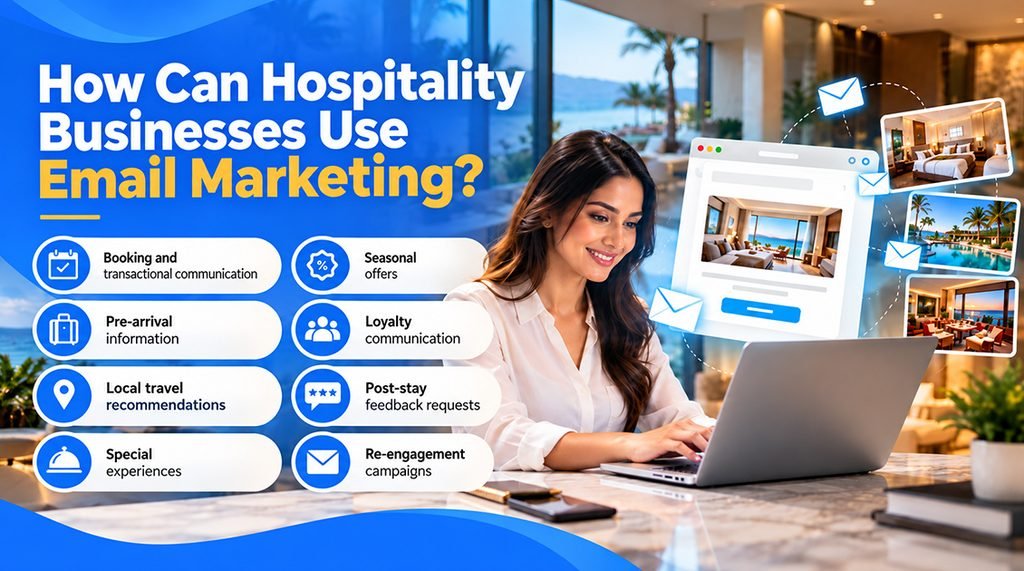
Email marketing in hospitality allows businesses to keep in touch with customers before, during, and after the stay.
Content should vary per the customer’s relationship with the business.
Otherwise a booking may just be confirmed with pre-arrival information to the person who booked it, or a return guest might be looking for a new experience at the property or advice about the current offer.
Use Email for More Than Discounts
A useful hospitality email strategy can include:
- Booking and transactional communication
- Pre-arrival information
- Local travel recommendations
- Special experiences
- Seasonal offers
- Loyalty communication
- Post-stay feedback requests
- Re-engagement campaigns
Personalisation can also improve relevance. For instance a business could tailor messaging by segmentation for past accommodation interests, booking history or customer type where relevant and with the necessary consent and data processing in place.
The goal is not to send a certain number of emails. The goal is to use a piece of communication for a reason.
How Does Reputation Management Affect Hospitality Marketing?
Online reputation reviews and website reputation can have an impact on the decision about where to stay as customers check reviews before making a booking.
The reputation management of hospitality products should because of this be considered as an element of the marketing process rather than the very last step coming into play when something (bad) is happening.
Monitor customer comments, provide professional response, and track general complaints.
Positive feedback will be useful in highlighting the elements of the guest experience that the photographs and advertising are unable to do justice to. Negative reviews will be key in identifying parts of the service or operation that require change and improvement. Avoid arguing and focus on the customer’s concern rather than defending yourself.
A more useful reputation management strategy then should be to integrate marketing with operations. When guests make the same complaints every time and respond only to reviews by just apologizing and not resolving their problem, this will not work.
How this system Can help Improve Hospitality Marketing Automation Managing leads One way it can be beneficial to the hospitality industry is that the system will be.
Using this setup will help visitor and lead generation work effectively as it suggests five best practices that can be adopted by the industry to show how the industry could boost its marketing automation, an aspect the industry is lagging behind in.
Different types of enquiry are made to hospitality businesses. For example, some enquiries may be from potential guests and some may be about a conference wedding event, restaurant, or corporate booking.
A hospitality marketing automation system can assist in taking charge of these encounters.
A CRM or marketing automation system can capture leads, segment them and trigger the right messaging.
For example:
Website enquiry → Lead captured → Enquiry categorised → Relevant response → Sales follow-up → Booking or event conversion
A wedding enquiry may have a different follow-up sequence to a standard room enquiry. A corporate event enquiry may require details of conference facilities and packages and availability.
Automation should help rather than replace the customer journey, removing human interaction when personal assistance is required.
What Metrics Should Hospitality Businesses Use?
Once the business knows what it is trying to achieve, digital marketing becomes all the more easier to refine.
Among the measurements a booking hotel will take into account the conversion rate on its website and the booking enquiries. While a resort hotel working more on awareness level will probably give more importance to organic visibility, destination content and relevant traffic coming to its website.
Some useful metrics include:
| Business objective | Metrics to monitor |
| Increase visibility | Organic traffic, search visibility, reach |
| Generate enquiries | Calls, forms, WhatsApp enquiries |
| Increase direct bookings | Booking conversions, website conversion rate |
| Improve paid campaigns | Cost per lead, conversion rate |
| Improve engagement | Social engagement, content interactions |
| Improve retention | Repeat bookings, email engagement |
| Improve reputation | Review volume, ratings and response activity |
The important point is to connect metrics with business objectives.
Common Digital Marketing Mistakes Hospitality Businesses Should Avoid
Even a business with the best products can fail online if the marketing experience slows things down.
Treating Social Media as the Entire Strategy
Social media can give awareness and engagement but it shouldn’t discount the website and SEO, local search, email, or direct booking strategy.
There is a design that more strongly links these channels.
Relying Only on Third-Party Booking Platforms
Online travel and booking sites might bring some good exposure but hotel businesses should think about how they add to their own assets and relationships online
If a dedicated website, customer database, rich content, social presence and better local search visibility are developed. This will be another channel for communicating with potential and existing guests.
Using Generic Visuals
They want first hand experience to envisage the property. The more generic the images are, the more difficult it will be for the prospective guest to picture the property.
Use high quality photography and video whenever possible.
Sending All Advertising Traffic to the Homepage
Any other promotion of a specific room/package, or event should direct visitors to a page explaining that offer.
The closer the landing page is to the ad, the potential visitor is already aware of the offer and what you want them to do.
Ignoring Reviews
Reviews are part of the research for many hospitality customers. Overlooking their importance can also potentially deny business groups information on where the needs of their guests are, or contact details of the operation.
A Practical 30-Day Hospitality Digital Marketing Plan
A hospitality business does not need to launch every marketing activity simultaneously. A phased approach can make the process easier to manage.
Days 1–7: Build the Digital Foundation
Start by reviewing the website, important property pages, booking or enquiry paths and Google Business Profile.
Check whether visitors can quickly find:
- Property information
- Room or service details
- Location information
- Contact options
- Booking or enquiry options
- Reviews and trust signals
At the same time, identify the main audiences the business wants to reach.
Days 8–15: Improve SEO and Content
Find out what searches potential guests are doing near your property, in the destination and around the type of accommodation or services you provide.
Research your important pages, then look to improve those pages and to find content opportunities.
Develop a short content calendar for destination summaries, questions for guests, property experiences and relevant commercial topics.
Days 16–23: Strengthen Social and Paid Campaigns
Create a consistent social media strategy with real estate and destination content.
Paid – if it is suitable then create tight focused campaigns for various individual target audiences, locations, services, or offers. Use landing pages for each campaign and have a clear conversion path.
Days 24–30: Review Performance and Improve Lead Handling
Examine website traffic enquiries campaign results and customer conversations.Determine where visitors are leaving.
For instance, the campaign may bring in visits but generate very few enquiry pages. The cause is not low traffic but problems on the landing page, the offer, the target group or the path to conversion.
Apply these results to boost the subsequent campaign instead of, year, and month is an end product.
Frequently Asked Questions About Digital Marketing for Hospitality
What is digital marketing in the hotel?
Digital marketing for hospitality encompasses all the online channels (SEO website social media, paid advertising email local search and reputation management) used to attract guests, generate bookings and engage with customers.
What are the effective kinds of digital marketing for a hotel?
Hotels should utilise a mixture of SEO, local SEO, content marketing, social media, Google Ads, email marketing, reputation management and website optimisation. The right mix would be influenced by the type of hotel location, target market, and business goals.
Why should hotel marketers care about SEO?
Yes. Your hotel can benefit from SEO by appearing to people who are searching for the accommodation destination hotel services or travel related searches. Local SEO is also important as, for example, hotel searches often mention a place.
In what ways can hotels increase their direct bookings?
Hotels can benefit from improving their opportunities for direct booking through the development of helpful organic visibility, ensuring their website is of a high standard, constructing relevant landing pages, communicating their advantages clearly and providing a simple booking or enquiry process.
In what ways social media can be a benefit to the hospitality business?
And it can be used to promote properties, experiences , locations, events, and our customers’ stories. The power of social media can also be used by hospitality businesses to communicate their personality.
Do hospitality businesses adopt paid advertising?
Paid campaigns may be useful when a business takes focused exposure on certain properties, services, audiences, or offers. Though the campaign must include suitable landing pages and be evaluated against relevant business goals.
What do you want to measure in a hospitality business?
The most useful metrics will depend on your purpose. For example, ROI may be the priority: websites url loading time, conversion rate, and performance of content and design. Otherwise: going views, page views, number of visitors and enquiries, booking conversion rate, effectiveness of the advertising campaign, social media and email performance, reviews, and repeat bookings.
How Can RG Startup Support Hospitality Digital Marketing?
An effective hospitality marketing system has to journey over a range of disciplines, rather than simply a collection of ad hoc advertising and publication. This includes: SEO content social media, paid campaigns, website optimisation, reputation, automation.
To cater for hospitality businesses requiring professional assistance, the RG Startup can be positioned with: hospitality SEO, hotel digital marketing, content marketing, social media marketing, paid advertising, lead generation and marketing automation.
First, she should consider the concept: what is the property/service, who are the target guests, where is the property, who are the competitors, what will be the guest journey and what are the commercial aims of the business.
A successful hospitality digital marketing strategy would then bring these ingredients into a more comprehensible system.
Visibility → Engagement → Enquiry → Booking → Guest Experience → Retention
Our goal isn’t to be on every digital channel. It’s to get the right digital footprint on the right audience and ensure every step of the guest journey is enjoyable, informative, and relevant.