Many patients now start their search for a hospital online. They may be looking for another local hospital, searching for the right department, looking for a particular consultant or expert, searching for available services, reading patient comments or simply browsing a hospital’s website before making an inquiry.
Because of this, digital marketing in hospitals is not only a channel to generate promotion for healthcare services, but also a channel to improve information accessibility, guide patients understand healthcare services, increase confidence and lower the complication for making inquiry and appointment.
Though, healthcare marketing needs more attention than marketing of many other industries. Hospitals carry sensitive data, doctors make important decisions and the patients are possibly exposed to stress and apprehension. Promotional communication has to be objective, credible, and transparent.
A good hospital digital marketing approach should unify SEO, local search content, social paid reputation management, email, and web optimization. It is not about using all channels just because they exist.
What Does Digital Marketing for Hospitals Include?
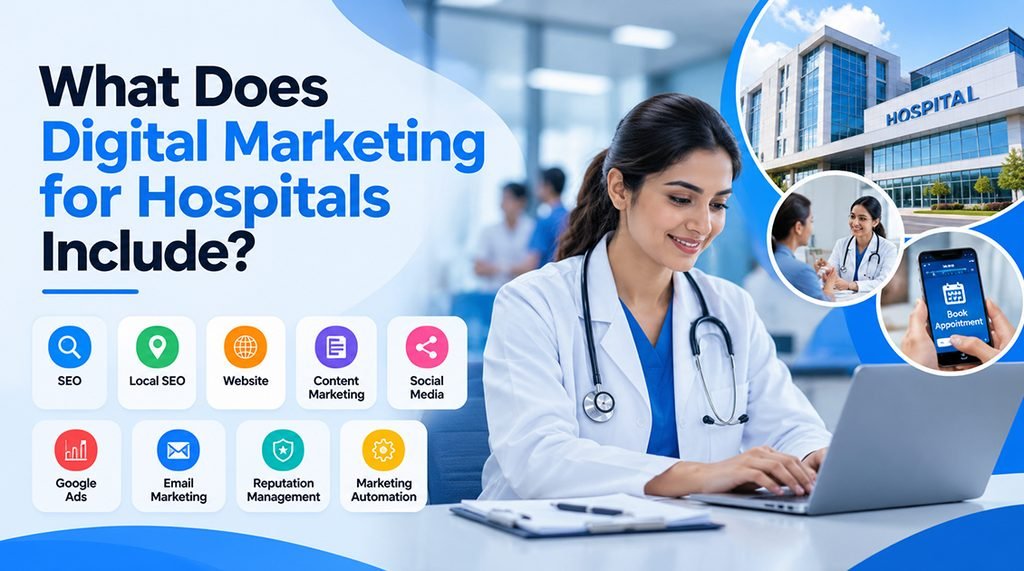
Hospital digital marketing refers to the relies on the internet, the web services to serve the purpose of the hospital’s visibility and presence online, deliver information that is useful, health care related messages and show case the areas of concern services of the hospital and also gives us with the means of communication through which the patients can put their queries and book appointments.
On the hospital, a digital presence may be represented by the hospital’s website, search engine listings, Facebook and Twitter pages, online discussions, library of knowledge, E-mail brand, and other paid information about the hospital.
The different channel fulfils a different function.
| Digital Channel | Primary Purpose | How It Can Support a Hospital |
|---|---|---|
| SEO | Organic search visibility | Help people discover relevant hospital services |
| Local SEO | Local discovery | Make nearby patients aware of the facility |
| Website | Information and conversion | Explain departments, doctors and services |
| Content marketing | Patient education | Answer common healthcare questions |
| Social media | Awareness and engagement | Communicate useful updates and information |
| Google Ads | Paid visibility | Reach people searching for specific services |
| Email marketing | Ongoing communication | Nurture relevant enquiries and relationships |
| Reputation management | Trust | Monitor and respond to patient feedback |
| Marketing automation | Efficiency | Organise enquiries and follow-up |
The optimal combination varies as the hospital’s services, target market, website design location, online presence, and business goals.
There are also required to apply various digital strategies for various departments in a hospital. To illustrate, maternity service, care units diagnostics dentistry cardiology orthopaedics, or prevention service will come with distinct patient searching paths.
How Should Hospitals Build a Digital Marketing Strategy?
A good hospital marketing strategy should be built around the target audience of the hospital and the information they are seeking.
Determine the key reasons before selecting a platform; for example, to help raise awareness of a department; increase enquiries about appointment; improve standard of visibility for particular treatments; share healthcare information; improve facilities for patients.
Awareness → Information Search → Service Evaluation → Enquiry/Appointment → Care Experience → Ongoing Relationship
Start With a Clear Digital Foundation
The hospital website itself needs to become the ultimate source of information rather than pushing all people to rely solely on social media or third parties. A professionally built, well-structured website makes this much easier to achieve.
Important information should be easy to find, including:
- Hospital location and contact information
- Departments and specialties
- Healthcare services
- Doctor and specialist information
- Appointment processes
- Facilities
- Opening hours where relevant
- Emergency information
- Diagnostic services
- Patient resources
- Frequently asked questions
The next step should be easy to find. If the client enters the name of a service, then they should be able to choose from a number of options, e. g. To call the hospital, ask for an appointment, contact a department, or get further information.
The visitor should not have to go through multiple pages to find out what the hospital does or how to enquire.
How Can SEO Help Hospitals Get Found Online?
SEO for hospitals assists healthcare providers in getting found in search results that matter when patients are conducting online searches for their healthcare needs.
Yes, search behaviour can vary markedly. An individual may be searching for a hospital close to them, a given department, a medical specialism, a diagnostic service or for information on a health related issue.
This translates to the need for useful information to be produced in hospital SEO instead of healthcare keywords.
Build Pages Around Actual Services and Search Needs
A hospital website should have clear, useful pages for important services and departments.
For example, a hospital may have dedicated pages for:
- Cardiology
- Orthopaedics
- Gynaecology
- Paediatrics
- Dermatology
- Diagnostic services
- Physiotherapy
- Emergency services
- Health check-ups
- Surgical departments
Use Healthcare Content to Build Search Visibility
Content can support SEO by answering questions that people commonly search for.
For example, a hospital’s content strategy might cover:
- What a particular medical test involves
- When a patient may be advised to consult a specialist
- General information about treatment options
- How to prepare for a diagnostic procedure
- Questions to ask during a specialist consultation
- General preventive healthcare information
Healthcare content is specific. It must be factual and responsible and shouldn’t present generic educational content as a diagnosis or personalised medical advice.
Things to remember: Search presence should never sacrifice medical correctness. Hospital based content should have suitable review procedures for discussing medical diagnosis treatments procedures or hospital care.
Why is Local SEO Important for Hospitals?
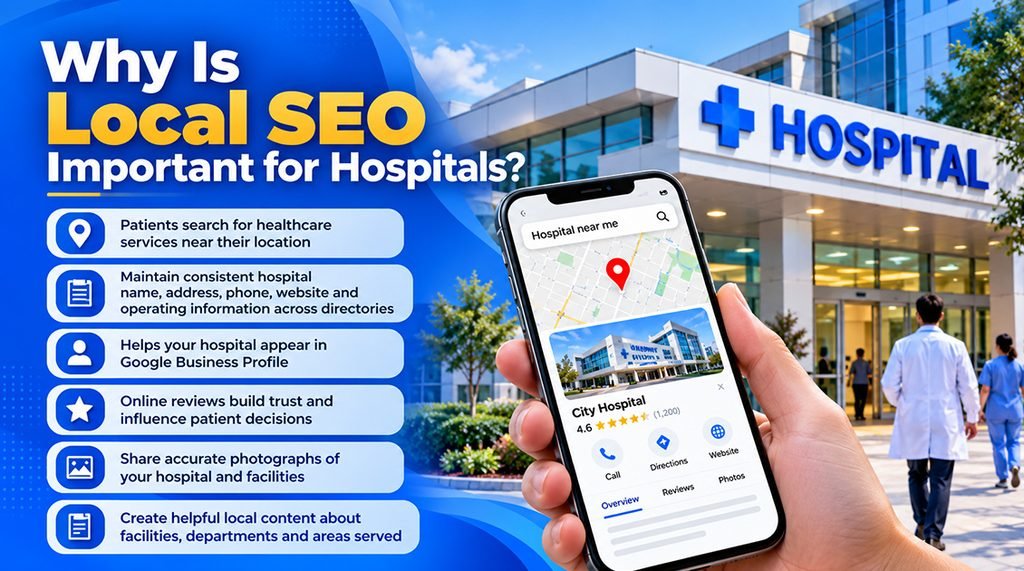
For many hospitals patients are seeking healthcare services in a sensible geographic range. This way hospital local SEO becomes an essential element to be visible online.
A hospital should adopt a consistent name telephone fax, website details across the key relevant online directories.
This includes:
- Hospital name
- Address
- Phone number
- Website
- Operating information
- Relevant categories
- Department information
- Accurate photographs
People may find the hospital through Google Business Profile.
Reviews are also part of the local search experience. It would be wise for hospitals to keep track of reviews and address them in a professional manner when needed. Confidential information should not be compromised in response to a positive or negative review.
Local content is another example. Rather than using several pages asking the same question as ‘where exactly is this hospital?’ try providing real information about the hospital’s facilities and access to the areas served.
How Can Content Marketing Support Hospital Marketing?
Hospital content marketing plays significant and hard to ignore roles because making health care decision whether minor or a major one does require the gathering of information before any action.
A person may not seek an appointment right away upon learning where the hospital is. They may want to learn information about a condition, a treatment, a diagnostic, a specialist, or a department.
By providing useful information to the education content this will help the hospital become a ‘go to place’ for information at this research level.
The content can include:
- Healthcare guides
- Department explainers
- Doctor interviews
- Procedure information
- Preventive healthcare articles
- Frequently asked questions
- Hospital service guides
- Patient preparation information
- General wellness resources
Connect Educational Content With Relevant Services
Content should follow logically through.
For instance, an article on a diagnostic procedure about ‘how to?’ Then can one put a link to a page that shows the relevant hospital department or the diagnostic service page. If the article is about a specialty it can help users to know where to look for.
This creates a natural progression:
Useful information → Service understanding → Trust → Appropriate enquiry
How Can Social Media Marketing Help Hospitals?
Social media marketing for hospitals enables healthcare organisations to reach out to their communities as well as to provide easier access to information that is important.
The social media sites could also be a platform of communication for educational material, health promotion campaigns, hospital department, or staff introduction, community, and all other appropriate uses.
But social media at the hospital should not go on and on with promotion.
A useful content mix could include:
- Health education
- Preventive healthcare information
- Department introductions
- Hospital facilities
- General awareness campaigns
- Healthcare professional insights
- Community initiatives
- Frequently asked questions
- Hospital announcements
The tone should remain appropriate to the healthcare context.
Build Trust Through Clear and Responsible Communication
In medical discussions, you get better and more reliable information from clear information rather than sensational headlines.
Say this to other health journalists/communicators if you necessarily have to insinuate towards fear for clicks then at least begin to communicate the issue clearly, and refer your readers on to the most suitable health and professional care.
Using social media also aids the listening side of healthcare marketing. Comments and questions show what consumers want to know – although specific medical issues should be managed by the relevant private channels and not in comments.
When Should Hospitals Use Google Ads and PPC Advertising?
Hospital PPC advertising enables healthcare organisations to target individuals who are looking for particular services.
For instance, hospitals can run search advertising on appropriate categories of service provided, hospital departments, diagnostic services, or searching for and booking appointments, among others.
For the hospital to show up on searches where people already desire what is being offered, Google Ads is the best tool.
But paid traffic also needs a landing page.
If the ad is for a specific healthcare service then most likely will make more sense if it directs users to a service page rather than always directing everyone to the hospital home page.
Match the Advertisement With the Landing Page
The basic journey should be consistent:
Search → Advertisement → Relevant Service Page → Clear Information → Appropriate Enquiry
Hospitals should consider metrics such as:
- Qualified enquiries
- Appointment-related actions
- Conversion rate
- Cost per relevant enquiry
- Landing page performance
- Search terms generating traffic
The exact metrics should depend on the campaign’s objective.
What Should a Hospital Website Do for Patient Acquisition?
A hospital website frequently equates to the point at which online interest turns into an enquiry. The marketing of hospital websites needs to revolve around visibility, but also usability.
Some clients/caregivers will come to the site with very specific questions. Relevance is more important than interactivity.
Create Clear Service and Department Pages
Important departments and services should have dedicated pages where appropriate.
A good service page can explain:
- What the department provides
- Which conditions or services it addresses
- Available facilities
- Relevant specialists
- What patients should know before contacting the department
- How to enquire or book an appointment
The information architecture should make sense to someone who is unfamiliar with the hospital.
Make Important Actions Easy to Find
Depending on the hospital’s systems, important actions might include:
- Book an Appointment
- Contact the Department
- Find a Specialist
- Request Information
- Get Directions
How Can Email Marketing Support Healthcare Communication?
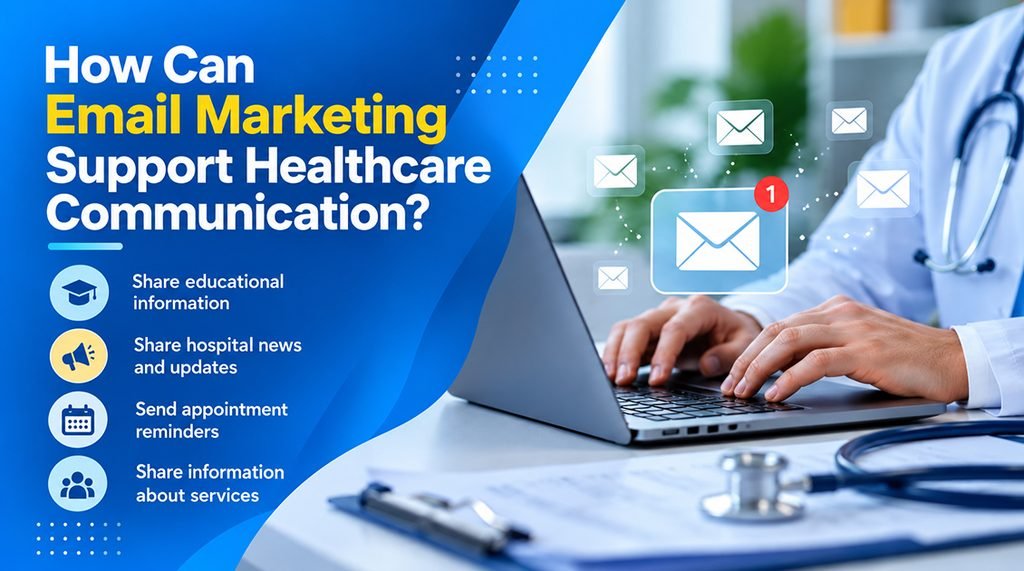
Hospital email marketing is important when reaching out to people who have taken the initiative to give their details and when this kind of messaging is appropriate.
Email should support these types of communication: providing educational information, circulating hospital news, circulating information about the services which the patient may be interested in, communication for appointments, and other communications that the patient’s consent is given to.
A simple educational sequence might look like:
- Welcome or confirmation communication.
- Useful information related to the person’s area of interest.
- Relevant educational resources.
- Information about available hospital services.
- An appropriate next step where relevant.
Email should be helpful rather than a burden. And, hospitals need to responsibly collect and maintain information on patients and contacts and comply with privacy and communication regulations.
Use of sensitive healthcare information should not be disclosed through the ‘personal marketing’ route.
Why Does Hospital Reputation Management Matter?
Trust should be also ensured by a healthcare provider as people tend to use trust as well to make their choosing decision. Digital marketing should include hospital reputation management.
Patients and families might be able to browse through online postings, go online to research the hospital, etc. They may also look at the hospital website and think about how others have said their experiences were.
Today you cannot simply ask for good reviews. Effective reputation management includes overseeing feedback, responding in a professional way, finding common issues within the responses and making changes to boost the experience of your patients if necessary.
Respond Carefully to Negative Reviews
Healthcare organisations have to be more cautious when reacting to patients’ complaints publicly.
A reply must state no personal medical information in the public domain. Any mention about one’s prescriptions, treatment details etc. should be avoided.
You could respond in a professional way, for example: It’s great to see your concern. Do get in touch via an appropriate private forum.
Reputation management should endeavor after the goal of establishing trust through transparency and responsible communication, not creating false online images.
How Can Marketing Automation Improve Hospital Lead Management?
They can have enquiries via websites, phone calls, social media, advertising campaigns and anything else. If not managed in a systematic way, it can sometimes become confusing to know where any enquiries are actually coming from and if they have been followed up.
Healthcare marketing automation can assist in managing recurring communications and leads.
A basic workflow might look like:
Website Enquiry → Lead Recorded → Confirmation → Appropriate Follow-Up → Appointment/Next Step
A CRM or other suitable system can help centralise information from different marketing channels.
For example, marketing teams may want to track whether an enquiry came from:
- Organic search
- Paid advertising
- Social media
- Direct website traffic
- Local search
What Should Hospitals Measure in Digital Marketing?
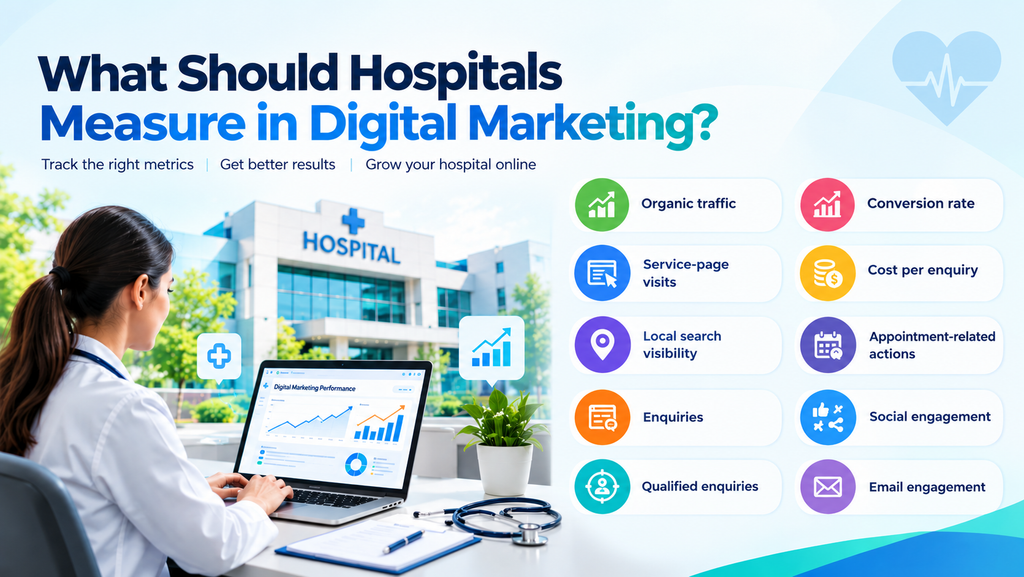
A hospital should measure marketing according to its actual objectives.
Website traffic is useful, but traffic alone cannot show whether digital marketing is supporting meaningful business outcomes.
| Metric | What It Helps Measure |
|---|---|
| Organic traffic | Visibility from search engines |
| Service-page visits | Interest in specific services |
| Local search visibility | Discovery within relevant areas |
| Enquiries | Direct response to marketing |
| Qualified enquiries | Relevance of incoming prospects |
| Conversion rate | Movement from visitor to desired action |
| Cost per enquiry | Efficiency of paid acquisition |
| Appointment-related actions | Progress towards patient acquisition |
| Social engagement | Audience interaction |
| Email engagement | Response to email communication |
The metrics need to be read in context.
For example, rising website traffic may be useful if it is relevant traffic, and leads to greater interaction. Rising website traffic will be useless if visitors arrive and immediately leave, or do not arrive at relevant service pages in the website.
That’s where analytics becomes much more helpful than merely reporting numbers. Ask: What are they doing? Then ask: What are the reasons for this happening?
A Practical 30-Day Digital Marketing Plan for Hospitals
Days 1–7: Review the Digital Foundation
Start with the website and online presence.
Review:
- Website usability
- Mobile experience
- Hospital contact information
- Department pages
- Doctor and specialist information
- Appointment pathways
- Google Business Profile
- Existing reviews
- Analytics and tracking
Identify the most important gaps before starting new campaigns.
Days 8–15: Strengthen SEO and Content
We should now look at organic visibility.
Investigate the healthcare services and questions that are most pertinent to the hospital’s target group. Examine the current service pages and consider other relevant educational content that could be added to boost the site.
Create a content plan based on the real informational needs of the patient rather than writing articles to cover all important keywords.
Days 16–23: Improve Reach and Lead Generation
Once the foundation is stronger, consider appropriate promotional channels.
This may include:
- Relevant Google Ads campaigns
- Social media campaigns
- Service-specific landing pages
- Improved calls to action
- Local search optimisation
- Content promotion
Paid campaigns should have clear objectives and appropriate tracking before a significant budget is allocated.
Days 24–30: Measure and Optimise
Look through the variation.
Review search visibility, web activity enquiries campaign success etc.
It is useful to note where people are dropping out of the journey.
For example:
- High traffic + low enquiries may require investigation of service pages or conversion paths.
- Low traffic + strong conversion behaviour may indicate an opportunity to improve visibility.
- High advertising clicks + poor-quality enquiries may require changes to targeting, messaging, or landing pages.
Common Digital Marketing Mistakes Hospitals Should Avoid
Treating Healthcare Marketing Like Ordinary Advertising
Healthcare decisions are based on trust and personal details. Trying to be aggressive and push products might threaten one’s reputation, so marketing management needs to concentrate on delivering information and exerting responsible publicity.
Creating Content Without Medical Review
The nature of healthcare content, mainly if it pertains to disease medication procedures, symptoms, or decisions, can affect how people interpret it. Due attention to reviewing under such conditions is necessary.
Focusing Only on Social Media
Social media can help support awareness, but it is just part of the digital journey. Search websites local presence, paid advertising content reputation, and follow up can all have different roles.
Sending Every Visitor to the Homepage
An individual looking for a particular service within a hospital should be able to find information about that service directly if possible. Landing pages, which carry relevant information can improve user experience.
Ignoring Local Search
Patients frequently require access to healthcare within a feasible region. Inaccurate business data, an obsolete profile, or incomplete local directory listings can make the discovery process harder.
Measuring Traffic Instead of Outcomes
High traffic counts are not necessarily indications of successful marketing. Hospitals need to link digital activity to appropriate conversions such as enquiry form completion, appointment activity, service activity etc.
Frequently Asked Questions About Digital Marketing for Hospitals
What really is digital marketing for hospitals?
Hospital digital marketing the effective use of web-based channels like websites, search engine optimisation (SEO), local search, social media marketing, content marketing, paid online advertising, email marketing, and reputation management to improve visibility, transmit information and enable suitable patient enquiries.
How about SEO? Does SEO make sense for a hospital?
Yes. When someone searches for a department service specialist or treatment, the hospital can have a greater presence in the search results. That’s if the hospital has the correct SEO strategy in place where information is provided accurately rather than the use of overuse of keywords.
How much to spend on digital marketing for hospitals?
No one budget fits all hospitals. There are different budgets for hospitals according to the number of beds, the type of services offered, competition, the local market goals website, the website content, advertising campaigns and whether you have marketing handled internally or a marketing agency.
What types of services can a hospital digital marketing agency offer?
Services range from search engine tuning (SEO), local SEO, content marketing, paid advertising, social media marketing and lead generation, website optimisation, reputation management, analytics, and marketing automation to whichever extent supplied by the digital marketing agency.
A hospital should investigate any agency to determine their business approach, knowledge of the industry, reporting procedures, communication methods and fit within their organisation.
How RG Startup Can Support Hospital Digital Marketing
Having a hospital’s website/blog/and other online presences is more than just shoot-and-post on Facebook, Instagram, or Snapchat. You need to integrate SEO, website improvement content, paid media, reputation management, analytics, and lead-generation systems all playing in harmony.
RG Startup can assist hospitals and healthcare organizations with digital marketing initiatives including SEO, content marketing, social media, paid advertising, website marketing and development, local search, lead generation and marketing automation.
The right approach would be to start by analyzing the hospital’s current position with internet presence, audience services, search engine visibility, website experience and marketing goals.
A bespoke digital marketing plan can offer a real practical starting point for a healthcare organisation wishing to optimise its web presence and establish a more structured route from search discovery to relevant enquiry.
Make Digital Marketing Work for Your Hospital
Digital marketing for the hospital must be focused on information access trust, and tangible business goals.
Build the basis – a good website, correct hospital details, useful departmental pages, good local presence and straightforward pathways to enquiry. Then use SEO and content to attract visitors to the relevant information, social media to support communication and awareness, paid advertising to target relevant searches that are looking to convert, and reputation management to promote confidence.
A more practical solution would be not to follow each evolution in digital marketing. Rather, it would be about understanding how people search for healthcare information and create a system that allows them to reach the right information more easily.
If all follow up SEO content, website experience, advertising, and reputation management work systematically, digital marketing can become a component of the entire process of communication and acquiring patients for the hospital. To get started, connect with the RG Startup team.