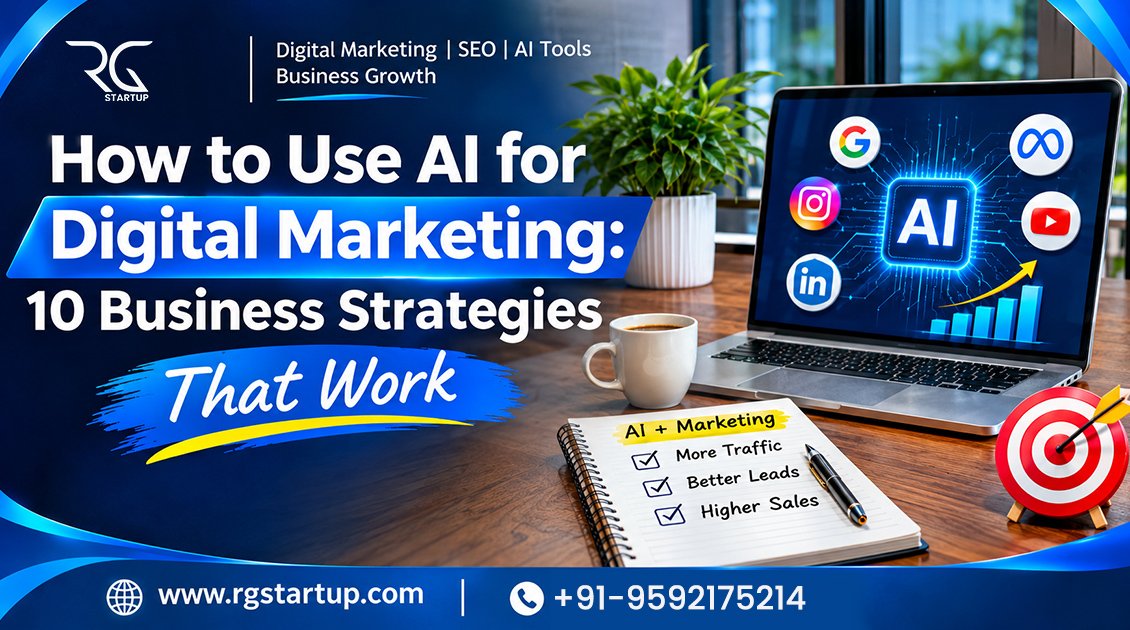
AI for digital marketing focuses on using AI technology for customer insights, generating marketing content, task automation, analyzing data from campaigns and marketing decision automation. It’s not about handing your entire marketing department over to a robot. The benefits of AI for marketing are derived from what it can do to assist marketers to gather large amounts of data in a relatively short time and identify patterns, trends and correlations which might otherwise have been missed.
Business AI For Digital Marketing Your Business AI can support numerous phases of a typical customer journey including: researching your audience, finding content ideas, making email marketing more personal, monitoring social activity, improving ad campaigns and predicting sales opportunities.
The value is when these capabilities are connected with a specific marketing objective. Conventional marketing experts are also now starting to emphasise the value of human direction, good quality data and AI as a way to enhance, but not replace, strategic thinking.
How Is AI Changing the Way Businesses Do Digital Marketing?
Even the most simple digital marketing already provides us with a large amount of data. People visit our website, we have clicks on our advertising campaigns, engagement on our social media channels, and clicks on our emails and CRM data about our relationships with customers. Not a lack of information but our ability to make good decisions from it.
AI Digital Marketing tools can read and act upon either automatically or in the form of a recommendation. For instance, it’s a marketer who employs AI to find the most-interested viewers, the considerations for fresh content, experiment with various ad kinds, or simply uncover what definitely induces chase down. It cuts down on drudgery and yields extra time for strategic actions and content material manufacturing.
The key difference is that AI is still isolated from, not replacing, marketing principles. Despite how differentiating generative AI features change, Google is still referred to as valuable, original, human-first content and old SEO best practices.
1. AI Marketing Strategy Starts With Better Market Research
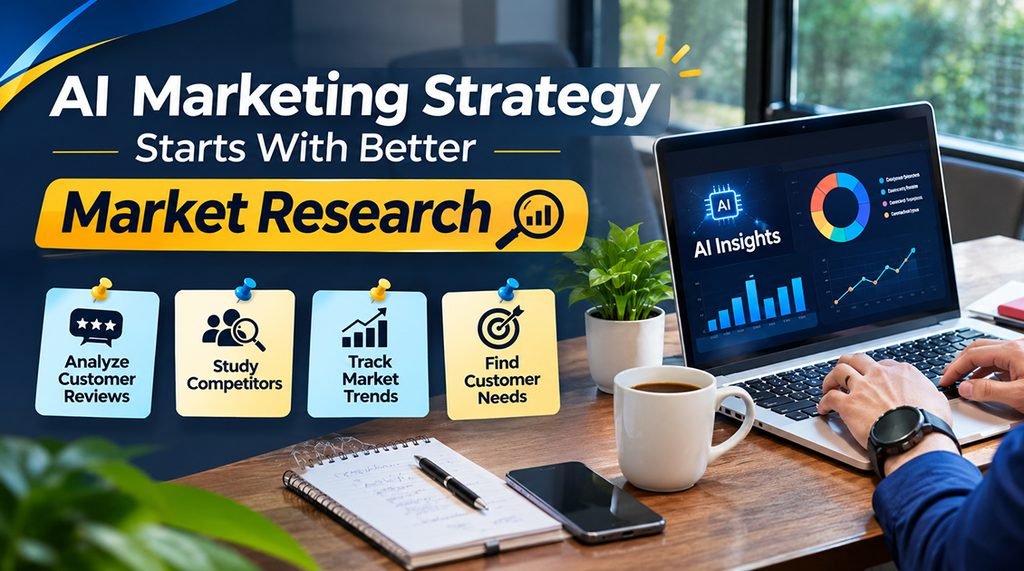
And before you even plan to start writing your copy and before you get down to launching your ad campaign, you have to know what it is that your customers actually want. And this is the moment when AI Marketing Strategies can be of great help and free up your research time. Segment customer reviews with AI, reduce questions, filter your competitors’ messaging, summarise a market or collect common issues.
The real secret is not to take what the AI states as truth and accept it at face value. Use it as a tool to get you close. Then test what it came up with against your customers’ data, sales conversations, search data, and knowledge about your space.. For example, the online course business may find from its customer success team that leads would prefer assistance with placement than a course outline, using that as a basis for website copy, content strategy, advertising, and email.
Network Solutions also mentions market research and strategy as a significant application of AI marketing, with some focus on trends, competitor research and pain points of customers.
2. AI Content Marketing: Create Faster Without Losing the Human Voice
Content creation.This is likely to be the best known use. We can give ideas for the AI to run with, develop the outline, research, write, edit poorly formed sentences, develop social captions and repurpose copy for a variety of channels and audiences. It can speed up the content creation process.
However, speed is not always an advantage. Content flowing into the site in huge quantities, most of it only related to each other by the AI that created it, also makes it appear like a “site like the others”. Google states that site operators should focus on writing content with value to readers and not creating thousands of lower quality pages generated using AI or other automation tools.
A stronger AI Content Marketing workflow looks more like this:
- Use AI for research, brainstorming, outlines, and repetitive editing.
- Add original examples, opinions, experience, data, and brand knowledge.
- Check facts, statistics, names, links, and claims before publishing.
- Edit the final content so it sounds like a business rather than a software tool.
3. AI SEO Strategy: Find Better Opportunities and Improve Existing Content
SEO is not about keyword density. But here are some other difficult SEO tasks that marketers must do: understand search intent, analyze content gaps, update architecture, report results, refresh the old pages and figure out where to put in the effort.
AI can be used on many of those.
How An AI SEO Strategy Can Assist Existing Content An AI SEO Strategy can define related search terms, subtopics, and content gaps, help you build content briefs, compare page structures, and even visualize pages that need to be updated. It can help marketers turn search data into bigger topic clusters, rather than each search term representing a new article.
Avoid falling for the fallacy that there are “AI ranking hacks” you can exploit. Google’s advice at the moment is that there is “nothing more technical” about “AI Overviews” or “AI Mode” in particular. And the standard proven techniques for SEO (crawlability, internal link structure, valuable content, page experience and people-first content) remain just as important.
– SEO analysis goes faster with AI. Not a replacement for a good SEO strategy.
4. AI Social Media Marketing: Plan, Personalise and Test Content
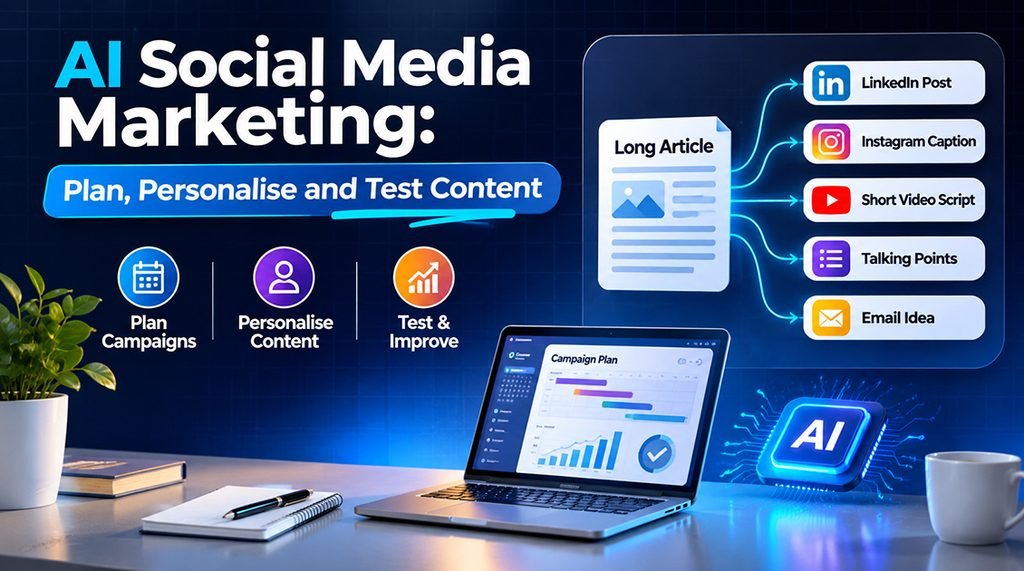
If you manage multiple social media accounts then social media marketing can be very time-consuming. Each of your accounts has a different community, type, volume of Posts, and engagement. AI Social Media Marketing will lessen the duplicated effort of editing content and file management.
For example, what if you could turn one long form article into a LinkedIn post, an Instagram caption, a short video script, several “talking points” and an email idea? It might even help you unpack why some of your earlier content worked and other content didn’t.
Then you can plan a campaign out instead of just posting randomly.
The brand should be still leading the creative. AI will offer 10 possibilities for a caption but a marketer will select one they believe to truly be the voice of that brand. Likewise, for humour, sensitive subject, complaint or a reputation query. Human moderation is key to this as online everything is public, is in the moment and contextual.
5. AI Email Marketing: Make Campaigns More Relevant
Less targeted than if you sent an email to all of your users on the same day. A purchase from a few days ago could be better targeted to a different email than someone who has never bought. Someone who’s repeatedly visited a specific product page could be better targeted with a different email than an inactive subscriber.
AI Email Marketing enables marketers to segment groups of prospects and customers associated with the campaign, recommends subject lines and personalizations, and reviews responses to messaging, and executes automated messaging to solicit customer response.
It makes a campaign seem far more targeted, without the need for marketers to generate hundreds of different versions.
For example your brand can create their own email journeys around new leads, existing customers, inactive subscribers or high-intent leads.
AI could tell you which content each group would be most receptive to while marketers could maintain the continuity of the content, offer, timing, and voice.
It’s more advisable than just putting out more emails. The overall lesson in this post is to always try and make sure every contact you make is absolutely relevant to the person receiving it.
6. AI Customer Targeting: Reach the Right Audience
Some visitors are new to a brand, some are considering their options and others are nearing purchase. AI Customer Targeting can offer insights into the visitors’ spectrum by exploring the behavioural and customer data.
Segments are not limited to cookies.
| Customer group | Possible AI-supported approach |
|---|---|
| New visitors | Educational content and introductory offers |
| Engaged visitors | Relevant guides, comparisons, or case information |
| Existing customers | Cross-sell, retention, or loyalty communication |
| Inactive users | Re-engagement campaigns |
| High-intent leads | Faster follow-up and relevant sales content |
Privacy should remain part of this process. Customer data should be collected and used responsibly, with appropriate permissions and safeguards.
7. AI Lead Generation: Turn Marketing Signals Into Better Prospects
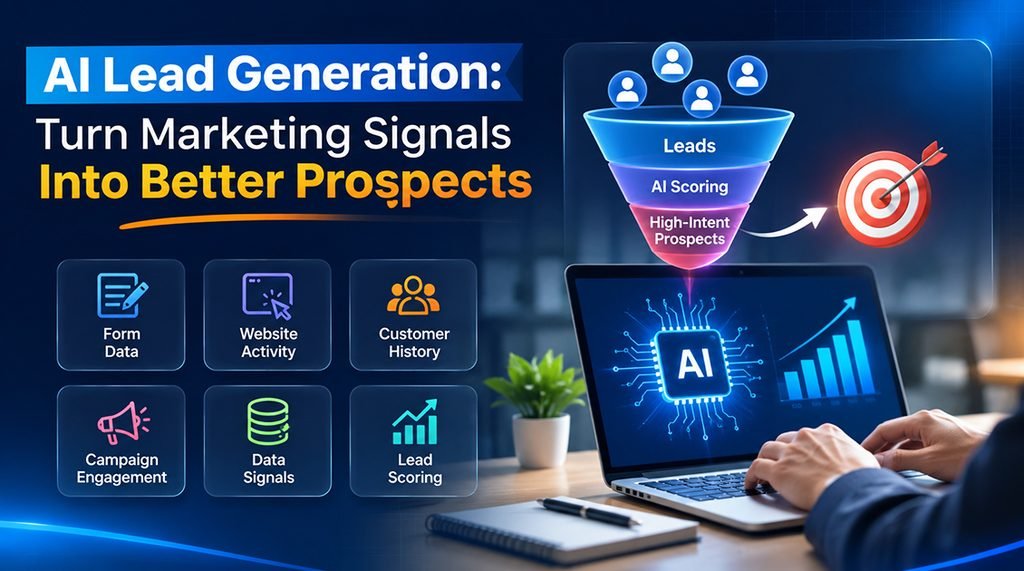
Generating hundreds of leads doesn’t do you much good if the vast majority of them aren’t going to generate. Use AI Lead Generation to leverage your data to find your better prospects and how you might be able to better reach them.
Leverage AI to evaluate data emanating from forms, website activity, customer history, campaign engagement and other indicators maintained within an organisation’s data estate. An organisation might evaluate signals to score leads for sales team outreach, or to identify which types of target audiences are most engaged with the campaign.
This may be practical for sales teams with limited time available. Instead of taking enquiries one by one, marketers and salespeople can design a more formalised method of prioritising the sales process with ‘high-intent’ prospects.
RG Startup digital marketing services include audience targeting, retargeting, lead generation strategy, content, seo, ppc, social media and analytics. The more advanced technical aspect it offers may extend as far as AI and automation integration, offering a chance for the client to link marketing efforts to other digital systems.
8. AI Marketing Automation: How to Save Time and Improve Campaign Performance
With the help of AI Marketing Automation, marketers are able to automate numerous tasks tied to email campaigns monitoring, sharing content reporting, identifying customer segments, and leading customers.
It’s not about automating everything. It’s about finding the boring steps in a process and using the computer to do that step and letting the people make the decision.
For instance: Suppose you create an AI workflow that, when a new lead enters, routes the lead down a new follow-up path and notifies a sales rep when it finds high intent. Your workflow will look different based on your use case and your data.
Another thing Network Solutions advises is to identify a narrow AI use case that they can use as a pilot before launching the solution in enterprise automation.
9. AI Ad Optimization: Improve Campaign Decisions With Real-Time Data
Paid Advertisements can be an expensive exercise and so optimisation is needed. AI Ad Optimisation can help understand signals for the campaign, so you can make decisions on bidding, audience, creative testing, spend and performance.
Some of those modifications are already occurring on present day advertising channels through Automated features by way of the usage of AI. However it shouldn’t imply that marketers simply turn each and every machine on and leave it. Marketing campaign objectives, budgets, high quality of audiences, creative method, and monitoring of conversions nonetheless want human oversight.
A winning AI Marketing Campaign needs to be founded on a clear goal. Is it what you’re after? Is it a product? A higher registration rate? More website visitors? Greater awareness? That will influence the data you need to optimise and optimise accordingly.
The most successful way is usually not total “hands off” advertising, but the combination of machine-led optimisation with human input.
10. AI Marketing Analytics: Turn Campaign Data Into Better Decisions
Marketing dashboards can get pretty overwhelming, pretty quickly. When you start collecting marketing data from sources like your Google Analytics account, ad account, social accounts, email marketing and the rest of your marketing systems, it can be all too easy to get a little lost.
Support for your campaign, full of data AI can assist in creating reports of lots of data, so can summarise massive data, identify outliers and major variations, compare your campaign performance against competitors or previous campaigns and identify anomalies or interesting variations that require further investigation. Instead of spending a long time creating a reporting dashboard, the marketer can invest the time in understanding why.
Useful questions include:
- Which channel is generating the strongest quality leads?
- Which campaigns are attracting clicks but not conversions?
- Which customer segment is becoming more engaged?
- Which landing pages need attention?
- Where has performance changed significantly from the previous period?
AI should help explain the data, not replace the underlying data checks. Major budget or strategy decisions should still be based on verified figures.
How Should Businesses Choose the Right AI Marketing Tools?
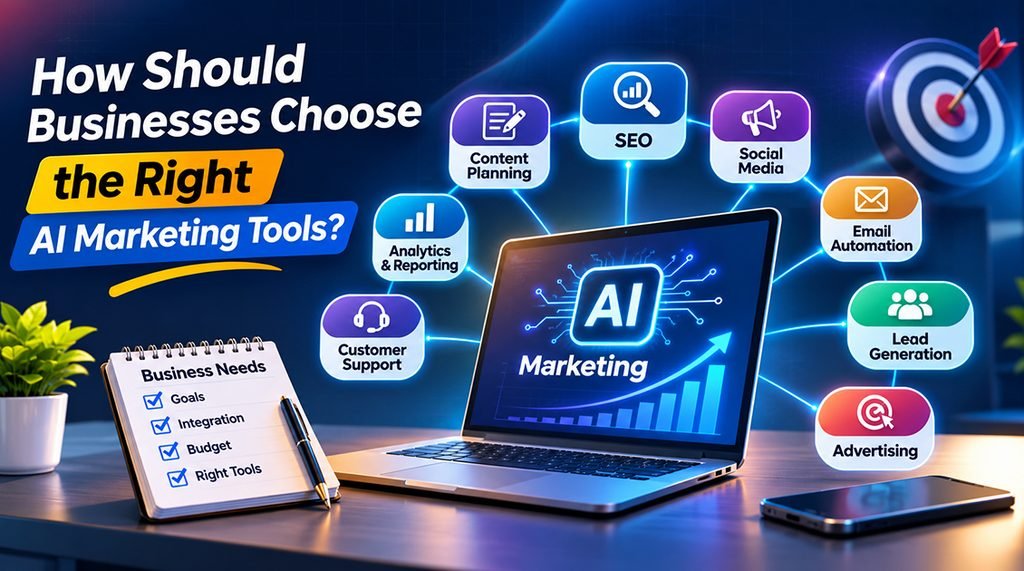
The investment in one “magic” AI tool doesn’t fix anything. Marketing needs many different AI tools. One might be best for content marketing, another for CRM automation, another for ad automation and another for analytics, SEO and so on. Buying all of those tools before knowing the problem just adds cost and yet another dashboard to administer.
| Marketing requirement | AI capability to consider |
|---|---|
| Content planning | Research, outlining, drafting and editing assistance |
| SEO | Keyword analysis, content gaps and optimisation support |
| Social media | Content adaptation, scheduling and performance analysis |
| Segmentation, personalisation and workflow automation | |
| Lead generation | Lead scoring, qualification and behavioural analysis |
| Advertising | Bid, audience and creative optimisation |
| Reporting | Data summaries, anomaly detection and insights |
| Customer service | Automated responses and enquiry routing |
It also helps if the tool integrates. A tool that can deliver excellent results but won’t integrate well with your CRM, marketing and analytics software can be damaging. Start from the business requirements then choose the technology to suit.
How Can a Business Implement AI for Business Marketing Without Creating More Complexity?
AI is better at taking the first step. A company doesn’t have to replace the entire marketing workforce on day one, it can test the waters by trying out one AI on one campaign to see if the technology stands up to the workload, delivers quality and produces results.
A practical rollout can follow this order:
- Cite one marketing challenge that is time-consuming or impacts on performance.
- Set a quantifiable goal for the AI-Assisted workflow.
- Ensure the customer and campaign information is correct.
- Choose a piece of technology that fits within the current marketing stack.
- Try out the entire process with a small campaign or audience.
- Review the output by hand and compare it to the previous process.
- Analyze Track performance before thinking of growth.
RG Startup finds solutions to digital growth by research, strategy, development, marketing, SEO, analytics, and technology. “We provide digital marketing SEO content strategy PPC social media and AI and automation so that kind of integrated approach can make sense for companies that do not want AI to be a stand alone part of their business plan, ” the company says.
What Are the Risks of Using AI in Digital Marketing?
Time-saver AI can be a time-saver; if used badly, it can also be a time-stealer. A fabricated, misleading claim from a machine can damage your reputation. Malfunctioning automation can communicate to your customer in a way you don’t want it to. Trashed customer information can produce unreliable segmentation. Over-personalisation can be repressive rather than engaging.
Here is another problem that can often be neglected by companies: sameness. If all other firms are creating identical blog posts, ads, emails, and social captions with AI, the mere application of AI won’t set you apart. Original thought becomes even more critical.
Google already has a similar message in its current guidance. Current advice from Google makes a comparable point. Businesses should focus on unique, useful, reliable, people-first content and should not rely on shortcuts or large-scale automated content created mainly to manipulate search visibility.
A human in the loop should continue to be involved – especially in end-user facing content, interaction with customers, sensitive subjects, advertising messaging, and critical financial decisions.
How Can RG Startup Help Businesses Use AI in Digital Marketing?
AI, it should be part of your entire marketing ecosystem – not just a set of individual features. You may need SEO, content marketing, paid advertising, social, analytics, website optimization, and automation to be aligned towards the same objective.
RG Startup says it takes a “Digital Approach” that includes various digital services such as: “digital marketing, SEO, social media, PPC, content, AI and automation integrations, web development, analytics and more.” Its “methods” also mentions “research, strategy, development and continual measurement of performance” in what it does.
Replace “What AI tool should I buy?” with “What marketing challenge do we want AI to address?” Once you know that, work back through the data, workflow, tools and human oversight you’ll need to address it – and how you’ll measure success.
That’s a far less intimidating starting place.
FAQs About AI for Digital Marketing
Introduction to AI for digital marketing
Ai for digital marketing includes research content seo, targeting automation advertising, analytics, engagement.
Will AI replace digital marketers?
Automation of routine tasks – this is where AI comes in – but strategy, creativity, specific decisions, market knowledge and review still is and will be firmly that of humans.
What AI marketing strategy should a business begin with?
Choose ONE of the following measurable problem areas (examples shown below): Content creation Lead scoring Email targeting Reporting Optimisation of campaign
Are articles written by AI SEO friendly?
Content produced by AI can be helpful provided it’s related, curated, edited and adds some value – but generating volume of low-quality content just to game the search rankings could violate Google’s spam policies.
How can AI support SEO by 2026?
Good quality research, data analysis, content planning, SEO optimisation and review of performance, and again, Google’s editorial recommendations still centre around the importance of quality SEO basics and useful, original content.
Does AI guarantee better marketing results?
No. It totally depends on the quality of the strategy, data execution, creative audience, offer and being ready to optimise.
How should businesses measure AI marketing performance?
Keep an eye on those metrics that are relative to your desired goal like qualified leads, conversion rate, customer engagement, cost per acquisition, revenue, organic visibility or time saved.
Is AI marketing suitable for small businesses?
Yes. Small businesses are able to start small by implementing a big AI system in phases. With use cases such as content creation, email automation, customer targeting, reporting, and ad optimisation.