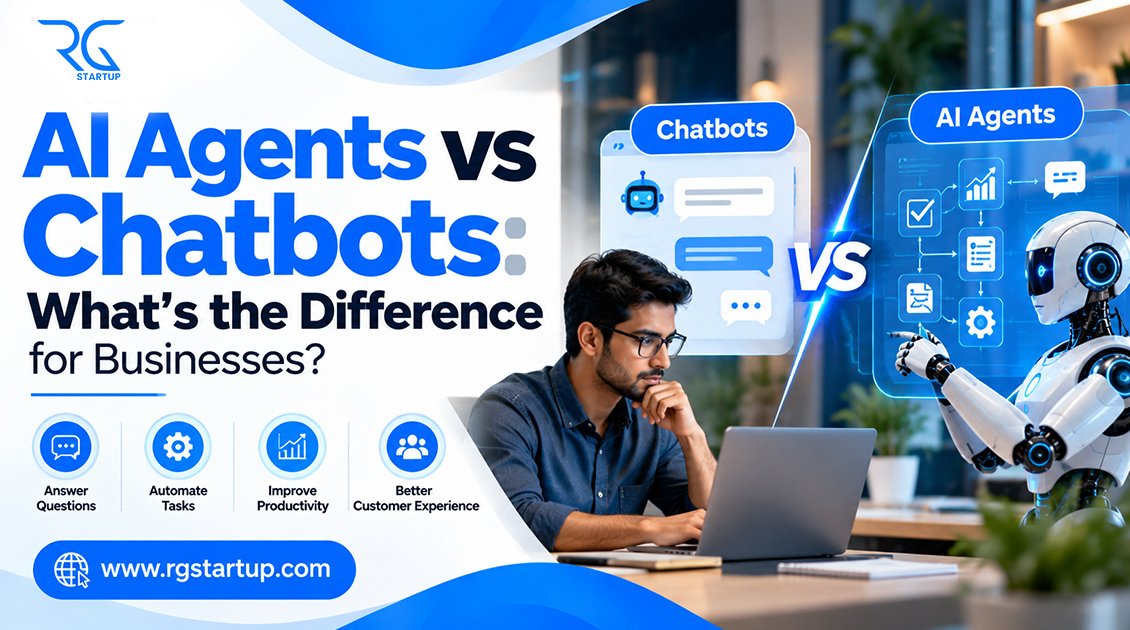
In fact, companies have been using chatbots for years to help answer customer questions, generate leads, and ease support teams. Yet, the capabilities of these AI agents are evolving the definitions of automation. It’s not just that one chatbot is running on more modern AI than a traditional chatbot. The real question is “what can the system do?” after a request.
Most chatbots are designed to chat, respond , refer, or provide information. An AI agent can do more, like pursue a goal, manipulate a suite of interconnected tools, make choices within limits, and perform several actions. That difference is significant when a company considers which automation to fund.
What Are AI Agents and AI Chatbots?
What Is an AI Chatbot? An AI chatbot is a chat bot that is built to interact with you as a user through text or voice. AI chat bots can be used to answer frequently asked questions, provide information about products and services, access a knowledge base, qualify leads or guide you through a process . AI chat bots use large language models, which allows the chat bot to act outside of a decision tree.
It has a wider goal for an AI agent: while an agent should not terminate after providing an answer, it can use the available tools and connected business systems to perform a task. As explained by OpenAI, agents are systems that can (mostly independently) carry out a workflow on a user’s behalf.
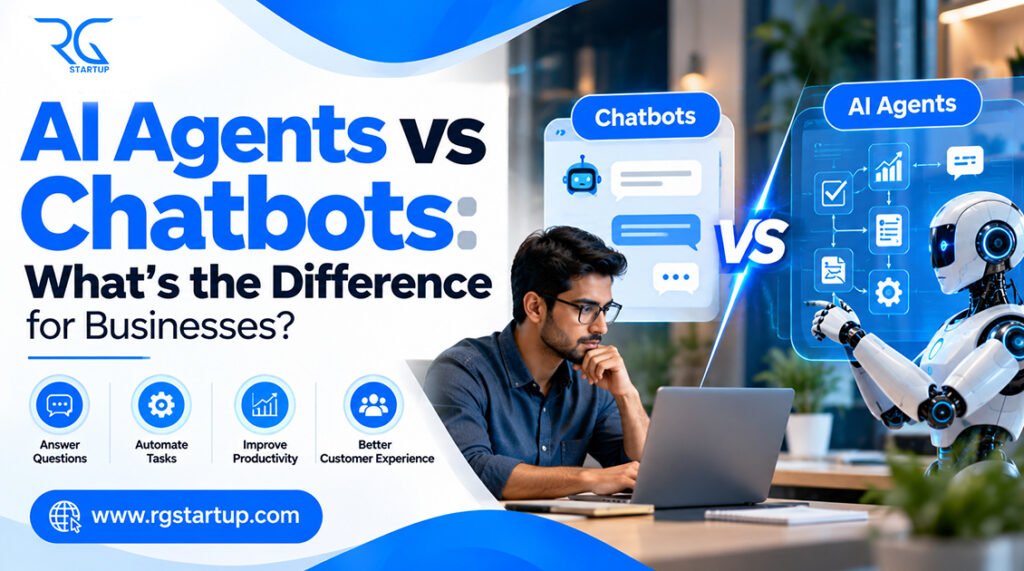
It simplifies that distinction quite a bit: a chatbot controls the chat, an AI agent controls what’s happening behind the chat.
AI Agents vs Chatbots: The Core Difference
The easiest way to do a side-by-side comparison of AI Agents vs Chatbots is to see what occurs once the user asks for something.
Customer: “Where is my order? For example, the chatbot can check the order status and inform the customer that the package is due to be delivered tomorrow. The agent could log into the order system, check on the package, see the delay in delivery, raise a support ticket, notify the customer and update the CRM.”
Neither way is necessarily better. Which option is best really depends on the problem.
| Business requirement | AI Chatbot | AI Agent |
|---|---|---|
| Answer common questions | Excellent fit | Possible |
| Provide product information | Excellent fit | Possible |
| Qualify leads | Good fit | Strong fit |
| Access multiple systems | Limited to integration | Strong fit |
| Complete multi-step tasks | Usually limited | Strong fit |
| Make decisions within rules | Limited | Stronger capability |
| Execute workflows | Limited | Core use case |
| Human oversight | Usually simpler | More important |
The distinction between answering and acting is evident in the industry as it exists today. According to Zendesk, Chatbots are “Conversational assistants. They help AI agents (machines) to understand intent, take advantage of the systems they are connected to, and work across multiple steps.”
Comparing AI Agents and Chatbots
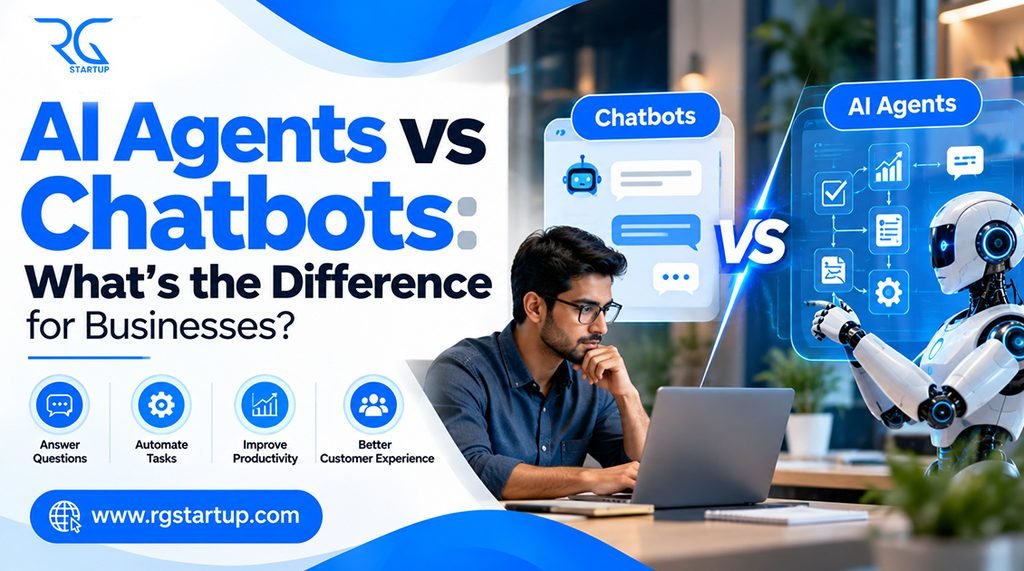
Business automation is not a single type of automation. For some businesses, business automation can consist of nothing more than eradicating the majority of common questions, for others it can be automating an entire sales, support, operational, or back office process.
In most situations, the business problem is primarily informational, and a chatbot can handle the workload. (A website chatbot, for example, can walk through and provide details about plans and prices, answer questions about hours of operation, and tell you more about its products and services – or direct you to the page you’re looking for.)
Once there are a few connected steps in the pipeline, it really begins to hit its stride.
Imagine a sales agent gets a new enquiry, captures some qualifying info, pulls up a record in the CRM, figures out what the next step is, sets up a meeting, and adds this to the sales pipeline (all as allowed by the business).
The trick is to automate the correct amount of work, not to select the most technologically advanced agent.
How Do AI Chatbots Operate Within Business Systems?
Standard Business Chatbots lean towards conversational.A user types a message, the requests are interpreted, data is retrieved and a reply is created.
But current AI Chatbots are much more flexible than old-fashioned chatbots as the large language models they contain can understand natural language and they do not require your customers to choose certain options. They can also be connected to company documents or records to generate responses.
Customer Chat Interface AI Model Knowledge/Data Response.
This represents a huge leap for customer service, as the majority of customer service enquiries tend to be the same.The first inquiry can be answered by the Business Chatbot and then the case can be escalated to a human.
What’s the difference in how AI Agents work?
The AI agent has a goal, not just a conversational reply.The agent reads the prompt, determines the data needed to fulfil the prompt, chooses an instrument it can access, executes an action, verifies an action, and loops until it reaches its goal or requires input from a human. .
The agents are listed in the OpenAI 2026 guide as follows: “Agents make use of models, tools, and guardrails to reliably, predictably, and safely solve multi-step tasks.”
For a business, this could mean an agent working with:
- CRM platforms
- Databases
- Email systems
- Calendars
- Internal knowledge bases
- APIs
- Ticketing systems
- Business applications
It is not the quantity of integrations that counts. It is the business process completion that matters.
AI Agent Benefits for Growing Businesses
The primary advantage of Business AI Agents is that they take the human out of the loop of the processes they’re connected to. Instead of simply automating a single step in the process, an agent can start to look at automating entire workflows.
Say you have a business where you receive hundreds of enquiries each week. The agent may have noted down some information about an enquirer and selected the tag, verified whether you have a customer record and then logged it in the customer database and allocated it to the relevant user.
Potential benefits include:
- Automating repetitive multi-step workflows.
- Reducing the amount of manual data entry.
- Connecting different business systems.
- Speeding up response and task completion.
- Supporting employees with research and information gathering.
- Handling defined processes outside normal working hours.
For all of those advantages come a responsibility; when an agent is granted additional power, the regulations of what it is permitted, what data it gets access to, what it monitors and what it escalates should really be more tightly defined.
Chatbot Benefits: When a Simpler System Makes More Sense
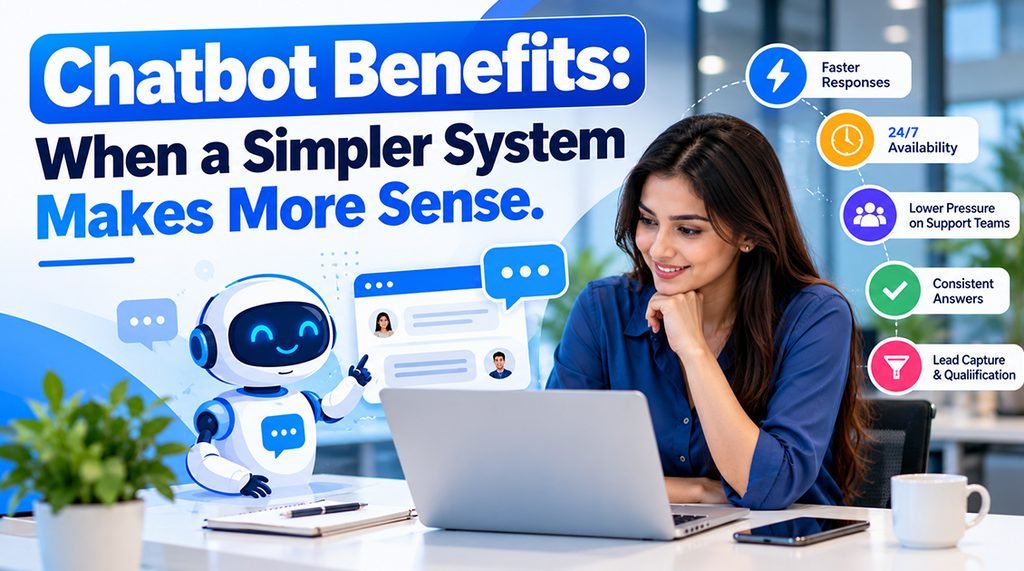
It’s tempting to assume that every company should swap its chatbot for an AI agent. Sometimes they shouldn’t.
Suppose that most of your customer requests have fact (right/wrong) answers that can be solved without an agent-based system. Think about a software vendor who gets a lot of questions about application features, account preferences, pricing and documentation. A basic Business Chatbot would suffice to handle all of those questions right away.
Chatbot Benefits often include:
- Faster customer responses.
- 24/7 availability for routine queries.
- Lower pressure on support teams.
- Consistent answers to common questions.
- Lead capture and qualification.
- Easy integration into websites or customer-facing channels.
The optimal automation isn’t the most complex automation. It’s the one that resolves the true bottleneck.
AI Agent vs Chatbot: Which One Is Better for Your Business?
Technology should never be the starting point. The starting point should always be the task.
Inquire about your aim for the machine. If the answer is “to answer customers with reliable information, ” then a chatbot may suffice. If the answer is “to present the customer with this request and to continue the process through different functions, ” then an AI agent is preferable.
A useful decision framework is:
| If your business needs to… | Consider |
|---|---|
| Answer FAQs | AI chatbot |
| Explain services | AI chatbot |
| Recommend products | Chatbot or agent |
| Qualify prospects | Chatbot or agent |
| Update CRM records | AI agent |
| Coordinate several systems | AI agent |
| Complete multi-step workflows | AI agent |
| Handle high-risk decisions | Human-led workflow with controlled AI support |
AI Customer Service: Chatbots or Agents?
A chatbot may even be able to go as far as answering a question like “What is your return policy?” or “How do I cancel my subscription?” without an agent’s help. For the more complex scenarios, an AI agent may (or could) obtain customer data, review an order, generate a case, update the record, and route the case to the appropriate team.
Which entails we’re getting a layered type of support in place of one chatbot or agent choice.
The first layer deals with simple questions. The second deals with defined actions.Human involvement should be in place for cases of exceptions, confidential information, judgement, complaints or actions that shouldn’t be fully automated.
That approach renders the Ai Customer Service more practical by utilizing automation only in cases where it adds the maximum value, instead of stuffing it into every encounter.
Where Business AI Agents Provide the Most Value
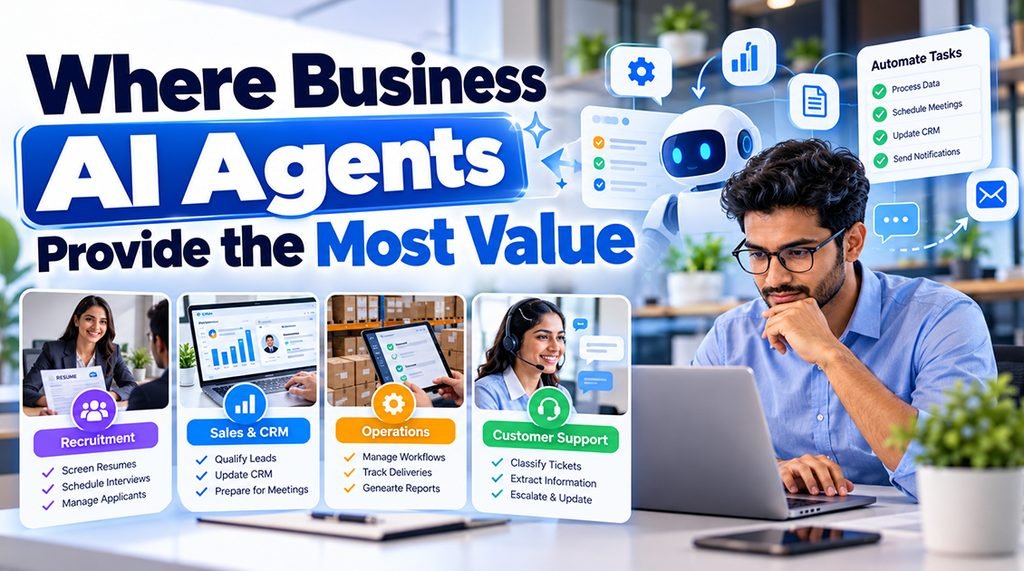
Such AI agents come especially useful when users constantly cycle through applications or carry out a sequence of steps.
Think recruitment. At a basic level you could have a simple chatbot to answer questions from job applicants. At a more sophisticated level, an AI agent could process new submissions to establish criteria, screen resumes, schedule interviews, enter data into the applicant-tracking system and send approved messages.
Other Possible Areas:
- Prospecting: lead qualification, updating CRM, preparing for meetings, making contacts.
- Operations: workflow management, routing, status tracking and reports, task tracking.
- Customer support: ticket classification, extract information, escalate update accounts.
- Internal teams: research reporting knowledge retrieval, scheduling, and the kind of stuff that is repeated over and over.
The business case is more compelling if the workflow is high volume repetitive, standardized, and already takes a notable amount of an employee’s time.
Chatbot Automation vs AI Agent Automation
Typically, chatbot automation is all about the interaction. A customer poses a question and gets an answer (or this may be the next step).
AI Agent Automation is all about the end result, not the journey. The dialogue is necessarily long to bring the human to the right solution. But it doesn’t need to be long! It can be triggered by e-mail, a system event, an automatic schedule, or a request.
This clarification is important because orgs usually call any kind of automation chatbot an ” AI agent”. It can give false hopes.
The best way to think about it is:
- Let chatbot automation handle the talking.
- Agent automation means automating a task or workflow.
You know this; so you know choosing the right technology is easy
What Are the Risks and Limitations of AI Agents?
But AI agents are orders of magnitude more powerful than a standalone chatbot, which means they also bring a lot more risk. If you have an AI agent that can start a CRM, compose an email, tweak a record, or complete a transaction, that will leave a much larger area of collateral damage for a rogue.
Agents and AI conversations could highlight permissions security monitoring, prompt injection, data, and human oversight.
In this manner, businesses need to set limits before going live. Critical questions include what the agent can access, what it can do on its own, which actions are approved, and what happens if it cannot confidently complete the task.
They’re not an optional addition. They’re part of the system.
How to Implement AI Business Automation Without Overcomplicating It
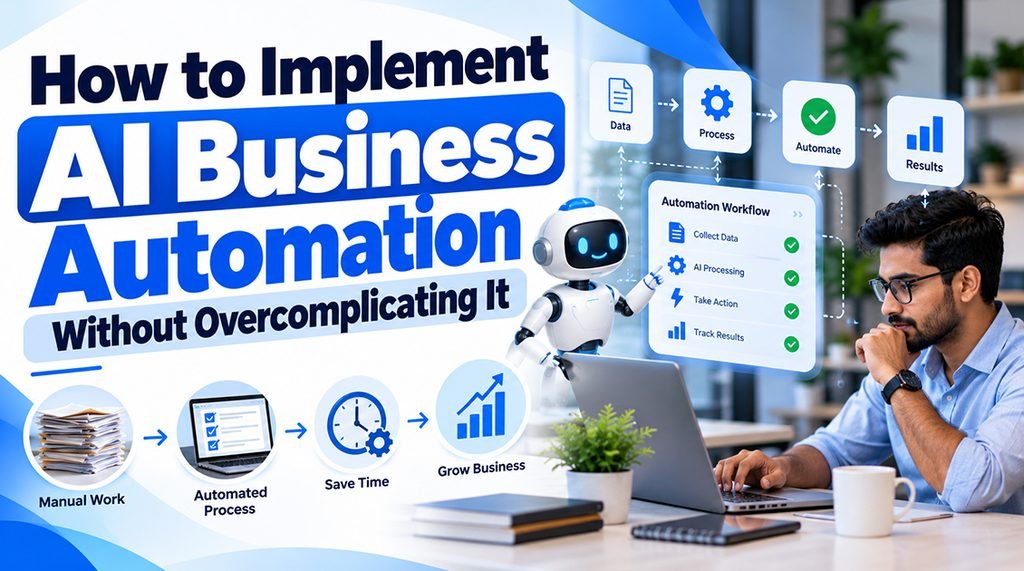
You build the tech and then look for a problem. The better way to do it is to start with an existing business process.
Identifying a process that is repetitive, predictable takes time, and can be measured fairly easily. Outline a current process on how your employees do it. Consider the systems used, what decisions have to be taken and where human judgement is required.
First, automate the one really useful workflow.
A practical implementation usually involves:
- Mapping the current workflow.
- Selecting the right AI model or agent architecture.
- Connecting only the necessary tools and data.
- Establishing permissions and guardrails.
- Testing normal and unusual scenarios.
- Adding human escalation.
- Measuring results after deployment.
- Expanding only after the first workflow is reliable.
How RG Startup Can Help Businesses Choose the Right AI Solution
For a business considering AI Business Automation, their first question shouldn’t be ‘Do we need an AI agent?’ It should be, ‘Which part of the business can we make quicker, easier, or more reliable?’
And it can do so via the larger digital environment, rather than as a standalone feature. That’s because RG Startup has been working for many years in areas like website design and development, digital marketing, search engine tuning (SEO), app creation, AI and automation integration, cloud-based technology and solutions, and other related fields providing a way for businesses to attach AI functionality. RG Startup.
This may entail embedding an AI chatbot onto a website, integrating an AI assistant with a business data set or automating a more sophisticated workflow. The ideal implementation will be informed by the process data integrations, security needs and degree of autonomy required by the business.
So for RG Startup a good initial step might not be selling a “chatbot” “agent” to every business but understanding the workflow to begin with and then exploring whether it makes sense to use a chatbot or automations, agent, or a mix.
FAQs About AI Agents vs Chatbots
What is the main difference between AI agents and chatbots
While AI agents are more tool-using, multi-step task-oriented, and goal-directed, chatbots are more conversational and informational.
Are AI agents better than chatbots in business?
Not necessarily. Chatbots are often better for simple customer questions, agents are better for complex workflows.
Can a chatbot be an AI agent
You can add tools, workflows, permissions and decision logic to a conversational system, but adding an LLM doesn’t make it an agent.
Key Advantages of AI Agent
Agents automate multi-step work, integrate business systems, reduce repetitive manual work, and help employees to complete workflows faster.
Chatbots can quickly respond and handle repetitive customer questions, help with lead generation and reduce the routine support workload.
Should a business use both AI agents and chatbots?
Yes, A lot of companies can have a chatbot to have a conversation while agents are working on specific tasks behind the scenes.
How can RG Startup assist with AI automation?
RG Startup can help businesses to evaluate and implement AI, automation, websites, applications and connected digital systems as per their requirements. RG Startup-Services